Deciduous oak woodlands have long been essential to the ecology and culture of California’s north coast (Long et al. 2016). Oak woodlands are rich in floristic diversity, provide unique habitat for many species of wildlife, and have aesthetic and cultural importance to many landowners. However, changes to land management and disturbance regimes over the last century have altered species composition and ecosystem function, and deciduous oak species, including California black oak (Quercus kelloggii) and Oregon white oak (Quercus garryana), are in decline throughout much of their range. In particular, more than a century of fire exclusion has enabled the widespread encroachment of fast-growing, shade-tolerant conifer trees, especially Douglas fir (Pseudotsuga menziesii) (Cocking et al. 2012).
Conifer encroachment results in a variety of ecological and economic impacts. Encroachment increases tree cover and density, which in turn increases vegetative water demand, and may in some instances decrease soil moisture and downstream water availability (Jones et al. 2013; Stubblefield and Reddy 2022). Douglas fir trees are generally fast-growing, and can pierce through and overtop the oak canopy within 20-30 years (Schriver et al. 2018). In this process, they reduce available light to the ground and shade out mature oak trees (Devine and Harrington 2006). In addition to causing mortality in oaks, this loss of sunlight has a direct impact on the herbaceous plant community and other plants that can be eaten for forage (Foster and Shaff 2003). The loss of forage and browse species negatively affects both wildlife species and cattle, presenting concerns across a range of stewardship goals. Furthermore, the risk of catastrophic wildfire increases with increased forest density and decreased tree health (Engber et al. 2011). Open oak woodlands are more resilient to drought and wildfire than their conifer-encroached counterparts (Beckmann et al. 2021).
A complicating factor in this encroachment paradigm is that the encroaching Douglas fir trees have timber value; they can be used to make sawlogs when they reach a merchantable size. Ranchers, who are the most common stewards in these landscapes, are also subject to the California Forest Practice Act and associated Rules. Enacted in 1973, these rules promote growing and sustaining conifers, which generally have the highest economic value. Since roughly 80% of California’s remaining oak woodlands exist on private property, decisions around oak conservation and restoration often rest with ranchers and other private landowners (Kelly et al. 2024). In 2018, California’s Forest Practice Rules were updated to allow landowners to legally remove and sell encroaching fir trees in order to restore two species of deciduous oaks that have significant ecological and cultural value.[1]
To provide insight to landowners weighing management options in conifer-encroached oak woodlands, we conducted an economic analysis that investigates the tradeoffs of managing for Douglas fir versus oak woodlands. A mixed methods approach was taken to account for various private and public benefits of oak restoration, and for the costs and benefits associated with conifer removal. Quantifying the benefits of oak restoration in economic terms is not straightforward due to the non-market nature of many oak woodland values. And while the calculation of profits from timber harvest may be straightforward, data on costs and revenues are not publicly available. As a result, we required different methodological approaches to capture different components in a cost-benefit analysis.
First, we considered the direct treatment effects of fir removal on forage production from three experimental sites. Second, we calculated non-market benefits garnered from the literature and through an original survey administered to a sample of registered professional foresters, licensed timber operators, and landowners. A key component of these surveys was calculating the foregone profits from maintaining the land for ranching instead of timber, something we attribute to the cultural value of ranching (Bowditch et al. 2023). In our setting, managing the land for conifers is commonly the more profitable economic activity in absolute terms, yet many landowners still choose to ranch. Assuming landowners are fully informed, we can rationalize this by attributing the foregone profits to the landowner’s value of maintaining ranch operations on oak woodlands (due to improved aesthetics, perceptions of improved ecosystem performance, ties to culture and identity, or other benefits).
The costs and benefits associated with controlling conifer encroachment have not been studied for these systems. Prior work has focused on the economic tradeoffs associated with encroachment of woody species in other regions of the United States. The vast majority of these studies have sought to quantify the potential to increase forage production through control of encroaching species, and thereby support livestock weight gain and/or carrying capacity, while ignoring other potential benefits of control, including improved soil moisture, stream flows, and wildlife habitat (Johnson et al. 1999; Torell et al. 2005). An exception is Aldrich et al. (2005). They considered the benefits and costs associated with western juniper management on rangelands in northcentral Oregon. Their work suggested that juniper control is economically beneficial for ranching operations. The authors also determined that economically optimal management led to reduced soil erosion and increased quail and elk populations.
A key distinction between prior studies and our analysis is that the encroaching species previously studied (e.g., western juniper, redberry juniper, big sagebrush, etc.) had no economic value upon removal. Thus, comparing encroachment control costs and increased forage production for livestock operations was relatively straightforward. When considering Douglas fir encroachment in North Coast deciduous oak woodlands, it becomes necessary to evaluate the potential future revenue associated with Douglas fir encroachment in terms of harvest and sale of Douglas fir for lumber. Both the costs of timber removal and the benefits of timber harvest will vary with the age of the stand and thus are dependent on management strategies. While we do not consider these forest dynamics in this analysis, we make headway in better understanding the tradeoffs involved. This study is the first, to our knowledge, to provide a catalog of the costs and benefits of control of an encroaching species in a setting where the encroaching species has an economic value. We take a more qualitative and simple but holistic approach to understanding the economic tradeoffs associated with the management of oak woodlands, and leave the dynamic optimization problem to future research.
Study area
Our study area targeted private ranches in the Van Duzen River watershed in eastern Humboldt County, California. Douglas fir encroachment is a widespread phenomenon in the Van Duzen River watershed and is representative of the encroachment that is taking place throughout Humboldt County and other regions of the Pacific Northwest.
In this region, which is part of the Franciscan Complex known for melange characteristics, rock and soil types are highly diverse and mixed. Both clay and sandy soils are often adjacent to each other. Sandier soils support conifers and other tree species while clay soils support grasslands and some oak species. European-American settlers established ranches in the area that often have a portfolio of businesses, with forests managed for timber value, and grass and woodlands managed for cattle and for hunting game.
Regulatory framework
The legal context of forest management in California is key to understanding oak woodland management in this region. Much of the management of Oregon white oak and California black oak woodlands occurs on privately owned land and is subject to California regulations. California’s Forest Practice Rules, which mandate commercial crop trees be re-established following commercial timber harvest, have historically presented legal disincentives and, in some cases, prohibitions to active management of conifer encroachment in established oak woodlands. In other words, if conifers are cut and sold, new conifers need to be planted in the same site. This ensures that there will be a continuous supply of timber going forward and that stand degradation does not occur. The challenge has been that the goal of oak woodland restoration is to remove the invading conifers and not replant them to achieve ecosystem and cultural benefits.
In 2018, California’s Forest Practice Rules were amended, creating two legal pathways for the removal, utilization, and sale of commercially viable conifer trees in oak woodlands. In these encroached ecosystems, these new pathways removed the previous requirement for replanting conifers in areas where conifers had been removed. Both pathways apply to commercial-sized conifer encroachment (defined as greater than 12 inches at diameter of breast height) in areas where the oak basal area is greater than 35 square feet (ft2).[2] These two permitted approaches — the “exemption” and the “special prescription” — provide a way to manage the oaks and simultaneously gain some financial return on cut encroachment.
The two pathways vary in required forest stand conditions and costs. The exemption permit is designed for more streamlined situations and has limitations. It can only be used to facilitate the removal of conifers of fewer than 26 inches at 8-inch stump height and is limited to 300 acres in 5 years.[3] The special prescription permit has no ceiling on conifer diameter and is typically better for larger project areas. It is more flexible and can be used where there is more site complexity. However, the special prescription is a part of a much more detailed Timber Harvest Plan, which includes analysis of wildlife, botanical, and archeological conditions.[4] Landowners and professional, licensed foresters have only recently begun to utilize these new permitting pathways, but they are critical to understanding the economic tradeoffs associated with conifer encroachment. The most utilization has occurred in the Coast Range of California, where both oak species are present. The exemption has been used 64 times as of August 2023 (corresponding to 1,500 acres of oak woodland restoration) (Kelly et al. 2024).
Another noteworthy treatment option for Californian landowners is to participate in cost-share programs that are offered through both state and federal partnerships. Incentive programs though the Natural Resources Conservation Service (NRCS), U.S. Fish and Wildlife Service (USFWS), CAL FIRE, and other entities have been helping landowners manage encroachment for the last 15 years. These programs are particularly useful for funding treatments when conifer trees are small and do not have commercial value. As Douglas fir trees increase in size, so does the cost of treatment and biomass removal. These programs and their staff of technical experts have helped landowners gain knowledge and interest in how to restore health and function to these ecosystems (Kelly et al. 2024). In some cases, these cost-share programs have primed landowners to engage with larger scale projects.
Experimental sites
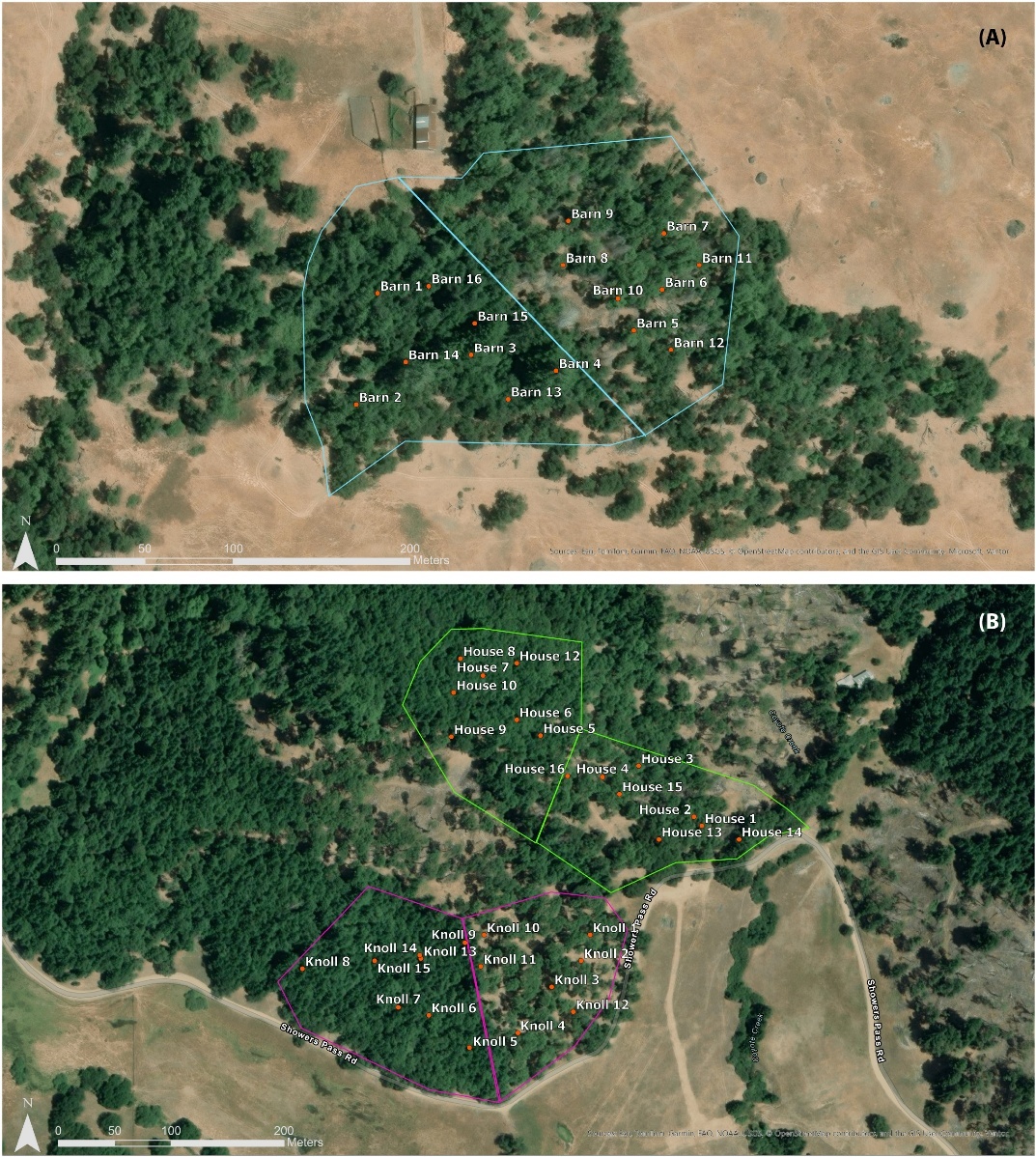
This economic analysis builds off an experiment conducted on private ranches in the Van Duzen watershed near Bridgeville, California. Experimental units were deciduous oak woodland sites that had been encroached by Douglas fir to varying degrees. Each of three 8-acre sites, shown in figure 1, contained both treatment and control blocks. The control plots saw no removal of conifer trees while treatment plots received manual removal. At each plot, annual forage production was measured, both before and after treatment.
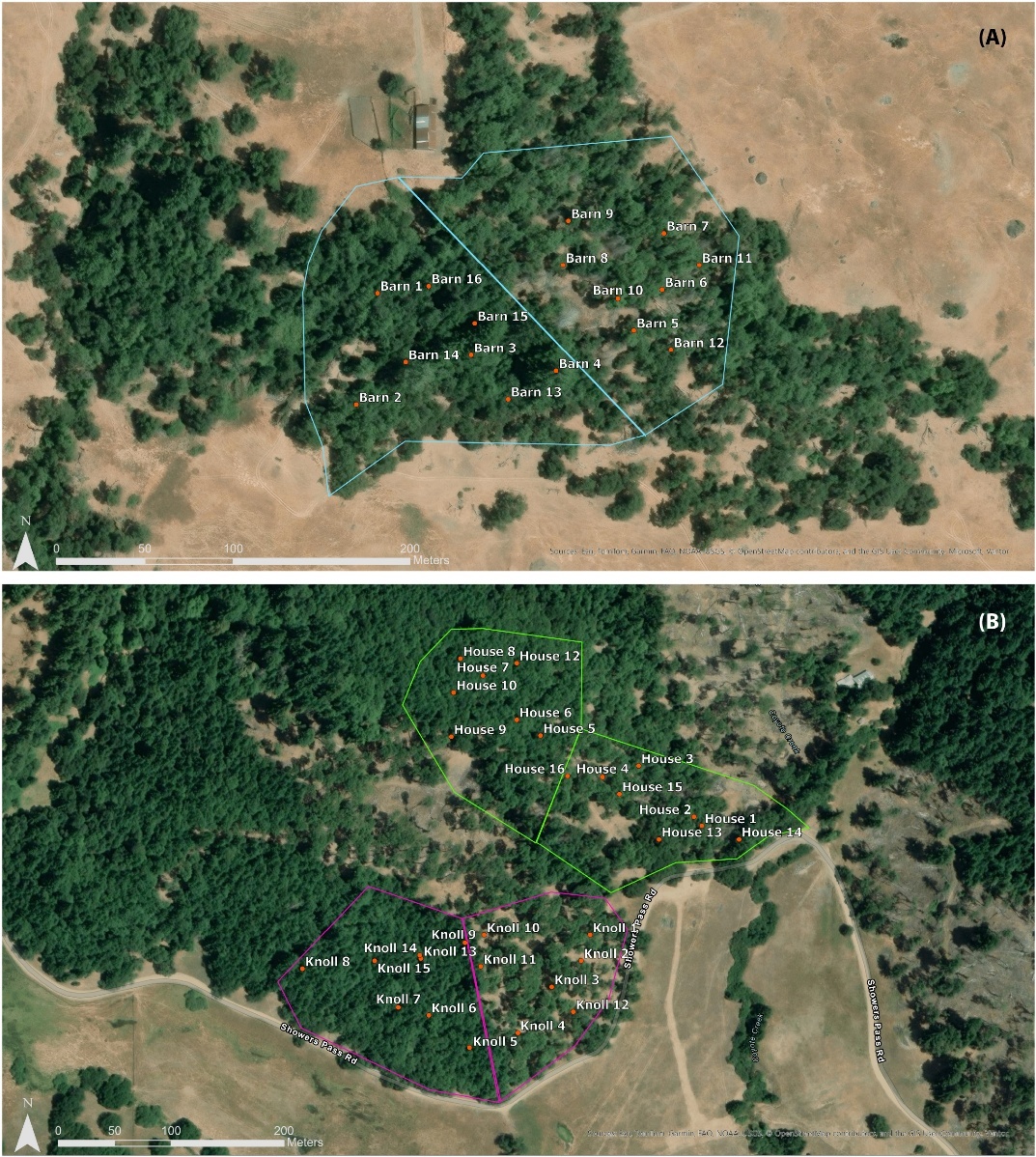
One practical objective of this project was to inform landowners and licensed foresters on the economic tradeoffs of Douglas fir treatments by tree size. Obviously, as encroachment advances in age and density, the treatment costs to remove those trees from an oak woodland increase. Similarly, as fir trees increase in size and density, so do the potential returns from fir harvests in the form of logs sold to the mill for lumber. Therefore, the research team identified three sites with three size classes of Douglas firs, each contiguous and large enough to house both a randomized treatment and control plot. For this analysis, our research team was specifically interested in mechanical control treatments, so we avoided areas with early stages of encroachment that would be suitable for prescribed fire or more minimal lop and scatter hand treatments. Our three target classes were as follows: (1) the largest stands of fir in oak woodlands that could utilize the exemption permit, where oaks were fully over-topped by firs; (2) a mix of merchantable and non-merchantable Douglas fir trees, where Douglas firs were both piercing the oak canopy and overtopping oaks; and (3) mostly non-merchantable Douglas fir, but still large enough to require manual removal (i.e., not removable with prescribed fire).[5]
Methods
Our approach for characterizing the economic tradeoffs associated with controlling conifer encroachment relies on different methods for different cost and benefit components. We utilize experimental results of conifer removal on forage production, estimates on non-market benefits from the literature, and data on timber value and treatment costs from an original survey to foresters, landowners, and licensed timber operators.
Fir removal effects on forage production
We first attempt to estimate the causal effect of conifer removal on forage production. Forage data were collected at three different sites with varying Douglas fir encroachment. At each site, there were treatment blocks where firs were removed and control blocks where firs remained within the oak woodlands. Within each treatment and control block, soils moisture sensors were installed in three distinct locations. In order to collect general forage production data for livestock utilization analyses, we utilized 0.96-ft2 vegetation sampling hoops and clipped and bagged the available forages at 5 and 10 meters in each cardinal direction, totaling eight vegetation samples collected adjacent to each soil moisture station. Samples were taken in July in an effort to match peak annual forage production. These samples were oven dried and weighed, and their averages were extrapolated to estimate maximum herbaceous forage production, by treatment, that would be available to livestock grazing in oak woodland pre- and post-fir removal. We calculated the difference in forage from pre-treatment levels to that observed 3 years post-treatment, and quantified this change in monetary terms by multiplying the difference by the price of typical grazing lease rates and dry matter intake estimates of 2.5% of mature bovine body weight (estimating monthly consumption of a 1,000-pound (lb) animal to be approximately 25 lbs of forage per day).
Profits from commercial timber harvest
We conducted semi-structured interviews with 11 relevant stakeholders in Humboldt County from November to December 2023 to better understand the tradeoffs associated with conifer encroachment and its treatment. We first surveyed five licensed foresters actively utilizing the new forest practice permits for oak woodland management and gained considerable insight into how foresters think about removing Douglas fir trees from deciduous oak woodlands. We also spoke with four landowners and two licensed timber operators during this same time frame. Participants were recruited through fieldwork and both purposive and snowball sampling. Some interviews were conducted in person and others over the phone. All data from interviews were recorded in real time.
Interviews with stakeholders provided primary data on the costs of Douglas fir tree removal and the value of the harvested timber. We asked questions related to labor, rental equipment, and transportation costs associated with cutting Douglas fir. We also asked about the quantity of timber harvested, price, distance to the mill, and transportation costs of trucking the logs to a mill to gain a sense of the income generated from commercial harvest. Differences in responses informed us on how widely costs and revenues varied based on the maturity of the trees, the legal pathways utilized for removal of the conifers (the exemption or the special prescription), and the impact thereof on the profitability of the operation. The full list of survey questions by stakeholder type, as well as analysis of the responses, are included in the online appendix.
Our survey of foresters and landowners enabled us to estimate profits per acre of commercial timber harvesting. To compute revenues, we use the forester-reported price for sale of the logs to mills in thousand board feet (MBF) of timber. We also collected data on the range of their harvest costs by MBF, post-project cleanup costs, and hauling costs, from which we gained insights into their total costs per MBF. We combine this figure with average volume of Douglas firs per acre of encroached oak woodland. These computations are shown in equation (1):
Πharvest=V⋅(P−Charvest+Chauling+Cclean)
where Πharvest designates profits per acre from commercial harvesting of the firs, V stands for volume of Douglas fir trees per acre on encroached oak woodland, P represents mill payment price, Charvest harvesting costs, Chauling hauling costs, and Cclean post-project cleaning costs, with price and costs being calculated per MBF. Profits are given by total revenues minus total costs. We received ranges for each variable from each respondent, which we averaged to obtain a point estimate by respondent. We then computed a weighted average across all respondents, with the weights being the number of exemptions and special prescriptions filed.
Valuation of other public benefits
The next part of our analysis addresses indirect effects of Douglas fir removal, such as improved opportunities for recreational hunting and reduced wildfire risk. These effects of Douglas fir removal cannot be computed with experimental data collected on the sites directly. As such, we relied on both published literature and interviews with different key stakeholders (licensed foresters, licensed timber operators, and landowners) who have participated in oak restoration activities to collect necessary data.
Value of hunting
We proxy for the value of wildlife with the value of hunting opportunities on the land. To capture the value of hunting, we need two different types of information. The first is an estimate of profits that are made (or could be made) by landowners per acre of suitable land for hunting sales. The second is how hunting land is impacted by the presence of oak woodlands as opposed to Douglas fir forests.
However, the evidence we were able to collect on hunting profits was limited, as most of the landowners we surveyed either do not monetize hunting, keep it for friends and family members at no cost, or allow it in exchange for favors that could not be easily monetized. One landowner gave us an estimate of yearly average hunting income on his property, which we used. Furthermore, we assumed for this exercise that hunting is not possible in conifer forests. This is a strong assumption, but we relied on vegetation data from our experimental sites, which showed no forage growth in these thick Douglas fir forests. Since the only game animals mentioned in the hunting interviews as target species were ungulates, Roosevelt elk (Cervus canadensis roosevelti) and Columbian black-tailed deer (Odocoileus hemionus columbianus), we assumed that either herbaceous or woody browse vegetation would be a necessary vegetation class to be considered suitable ungulate habitat. We thus assumed that hunting profits only accrue to landowners with the presence of oak woodlands, though we are aware that other habitat types around a property affect the presence of wildlife and that ungulates also utilize coniferous forests.
Under these assumptions, we computed the per acre value of hunting as the per acre returns to running a hunting operation in oak woodlands, Πoak, subtracted by the per acre returns to running a hunting operation in Douglas fir forests, Πfir , where Πoak is the average of per-acre hunting profits in oak woodlands and Πfir is assumed to be equal to 0:
Πhunting= Πoak−Πfir
=1N×TN∑i=1T∑t=1πoakit−0
where are hunting profits per acre for owner i and year t. We averaged hunting profits per acre across years T and landowners N.
Value of reduced wildfire risk
We did not collect primary data to estimate the benefits of reduced wildfire risk; however, we can rely on existing evidence to produce a back-of-the-envelope estimate. Loomis and González-Cabán (2008) estimated the willingness-to-pay (WTP) for mechanical fuel reduction for a subset of the California population in 2001 (WTP2001) using contingent valuation methods. They reported a mean annual estimate of $510 per household. Their results applied to a reduction in the number of acres affected by wildfire from 362,000 acres to 272,500 acres each year, for a total of 89,500 acres saved. Since fuel reduction programs benefit everyone in the surrounding region, these values can be multiplied by all regional households to arrive at a total annual value. These total annual benefits would accrue in all years where the fuel reduction program is effective.
To yield an appropriate per-acre estimate for our purposes, we first adjusted Loomis and González-Cabán (2008)’s WTP2001 estimate by the observed inflation rate between 2001 (the year their survey was conducted) and 2024, I2001,2024, to account for the change in nominal prices between these time periods. We then divided it by the number of acres the WTP question was associated with:
Πfire=WTP2001I2001,2004×1acres.
We can then multiply this per-acre value by the population of our study region for an annual estimate of the benefits of mechanical fuel reduction that would apply to each year in which the fuel reduction practices were effective in preventing wildfire.
Cultural value of ranching
In our setting, managing the land for timber is usually the most profitable economic activity, yet our interviews and other observations revealed that landowners often prefer to sustain open grasslands and woodlands for ranching. We refer to this implicit value placed on ranching as the cultural value of ranching. A key component of this survey was calculating the foregone profits from maintaining the land for ranching as opposed to timber by estimating the difference in profits between ranching and timber harvesting.
We estimated profits from commercial timber harvesting (Πharvest) in equation (1). We next computed landowner profits under ranching. For that, we asked landowners to give us information on their annual profits from livestock production over the last 4 years. Their answers are discussed in appendix section 1.2. We averaged profits over the 4 years within each ranch and then computed acre-weighted average profits.
Finally, we computed the cultural value of ranching as the difference in per-acre profits for landowners who harvest Douglas firs on their property. The per-acre average cultural value of ranching is simply given by:
Πculture=Πharvest−Πranching.
This is likely to be an underestimate since harvesting merchantable timber from encroached woodlands (for oak restoration) will be much less profitable than managing the land for timber. This is because there are often more defects in the conifer trees due to these trees physically growing through existing oak canopies, garnering a lower mill payment, and because trees are often harvested at smaller sizes during restoration projects (before the oaks succumb to shading by the fir trees) and thus face higher handling costs. Additionally, the cost of harvest is higher in oak woodlands because the timber operator must slow their harvest rates to ensure that they are protecting the oak trees they are trying to save. Conversely, when doing a more traditional harvest, production rates are higher, hence the cost of harvest per unit of timber produced will be less.
Results
Forage
Using measurements from 96 samples taken in July of 2023, we estimated forage production to be 732 lbs/acre on average across treated plots (table 1). No forage was detected in control plots or in treated areas in 2019, prior to treatment. Therefore, the average estimated forage production in 2023 represents the treatment effect of conifer removal.[6]
This translates to a maximum of 29 days of feed per acre for a 1,000-lb cow eating approximately 25 lbs per day (consuming 2.5% of body weight per day with 100% grazing efficiency). Suppose 50% of the total herbaceous growth is actually consumed (14.5 days/acre). Assuming $28/animal unit month (AUM) (or $0.93/day) for the price of forage, we estimate the per-acre value of forage to be $13.48 by multiplying 14.5 days/acre by $0.93 per day (table 2). Assuming constant treatment effects in each year starting in t = 3 this value of $13.48/acre would be achieved in each year before encroachment reoccurs. If, however, forage growth responded dynamically and increased over time, or began earlier in time, these treatment effects would represent a lower bound.
Timber or wood products
Using data from five foresters that we surveyed, we estimated profits from commercial harvesting of Douglas fir to be $136.98 per acre. Costs and revenues for the calculation of equation (1) are shown in table 3. This represents a one-time earning that occurs in the year of conifer removal. This profit estimate reflects the fact that Douglas fir trees growing among oak woodlands are more likely to have defects, and thus receive a lower mill price, and are more difficult to harvest relative to trees in healthy conifer stands. Thus, this estimate reflects potential benefits from managing oak woodlands, as opposed to the value that could be attained by managing the land exclusively for Douglas fir.
Ranching
Profit estimates for ranching were more difficult to estimate and relied on survey responses from two landowners (from ranches of size 9,300 acres and 15,000 acres). Although we interviewed five landowners, only two provided estimates of their net returns to ranching. Averaging across the years and between the ranches, annual per acre profits were estimated to be $8.19, substantially lower than per-acre profits from commercial timber harvesting (table 4).
Summary
Net benefits of treating conifer encroachment are summarized in table 5. The largest benefits of maintaining oak woodlands stem from reducing wildfire risk, estimated at an annual value of $555.34 per acre. Value is also derived from the upfront commercial harvest of the encroaching timber ($136.98/acre) and maintaining the cultural value of ranching ($128.79/acre). Small annual benefits also arise from increased forage production ($13.49/acre) and maintaining hunting habitat ($4.44/acre). Other non-market benefits, such as changes to streamflow and biodiversity, were not included.
Estimating the total value of oak woodland restoration involves adding the values of each component and accounting for the year in which it occurs, as shown in equation (6). We discount at rate r to put all values in comparable units. The net present value (NPV) of oak woodland restoration is expressed as the discounted stream of net benefits in each year t (NBt):
NPV= t=T∑t=0NBt(1+r)t.
Consider a 5-year time horizon (T = 5) where commercial timber harvest occurs in the first year and the benefits of restoring the oak woodland occur in each subsequent year. Five years is a reasonable return interval for treatment. If one wanted to do a commercial harvest and then maintain the oak woodlands thereafter, new encroaching Douglas fir trees would likely need to be treated with herbicide, prescribed fire, or hand treatment after about 5 years to prevent regrowth.
By putting values on a per-acre basis, we implicitly assume values scale linearly in relation to acreage. It is important to note that responses to the treatment of conifer encroachment could enter the NPV calculation non-linearly, if, for example, benefits to wildlife or wildfire require a minimum amount of land to have a meaningful effect, or if a region already has enough acreage to support these benefits that additional area is less valuable.
Using a discount rate of 2% and a time horizon of 5 years, we estimate the present value of the stream of net benefits from treating conifer encroachment to be $3,420 per acre.[7] The NPV of treating encroachment falls to $3,237 at a 4% discount rate and $3,070 at a 6% discount rate, suggesting that net benefits are meaningful even at higher discount rates that may be more reflective of the time preferences held by private landowners. The costs and benefits of treating encroachment depend on management strategies, which are unique to each property and treatment area. As such, our results represent a starting point in understanding the tradeoffs associated with maintaining and restoring conifer-encroached oak woodlands.
Other benefits
Revenues from hunting were also difficult to quantify since few landowners formally allow hunting on their properties. One landowner reported his annual earnings, which we converted to a per-acre value of $4.44 per year.
Table 6 summarizes the estimate of the benefits of mechanical fuel reduction derived from Loomis and González-Cabán (2008). Since fire prevention is a public good, the benefits of fuel reduction will apply to all households in the region.[8] Assuming this estimated WTP for fuel reduction applies to the nearly 55,000 households in Humboldt County, we estimate benefits of reduced wildfire risk of $555.34 per treated acre, which accrues in each year for which fuel reduction benefits are achieved.
Discussion and conclusion
With the exception of wildfire risk reduction, which benefits surrounding landowners and nearby populations, most of the benefits of restoring or sustaining deciduous oak woodlands that we characterized in this study accrue to the individual landowner and that property’s ecosystem services. This is important because the decision to manage the land for oak woodlands rests in the hands of private landowners. However, the social value of maintaining oak woodlands extends beyond the categories evaluated in this study. Increased tree cover from encroaching conifer trees could result in increased water demand and evapotranspiration, potentially leading to decreased soil moisture and decreased downstream water availability (Jones et al. 2013; Mata-González et al. 2021; Stubblefield and Reddy 2022). Additionally, the loss of oak woodland habitat may result in changes in biodiversity, wildlife habitat, and cultural resources that extend beyond ownership boundaries.
This study provides a first look into the costs and benefits of controlling an encroaching species in a setting where the species has an economic value. Our study tries to not only quantify these tradeoffs in monetary terms, but also provide a qualitative understanding through reporting on detailed interviews with key stakeholder groups.
One of the drivers of this research was to better understand the relative value of managing for timber versus managing for more open ground that supports ranching. Our results show that it is 10 times more profitable to manage for timber; however, many landowners invest time, energy, and money into oak woodland and grassland restoration, stewarding their lands in ways that promote and maintain ranching and hunting, even when those are not the most profitable pathways. This discrepancy speaks to the wide array of cultural and ecological values that are implicit in managing for oaks and grass. These landscapes are woven into the identities of the people who live there, providing motivation that extends beyond financial incentives.
This research also speaks to the importance of policies and programs that can offer subsidies to offset costs of oak woodland restoration work. Our results show that the largest benefit associated with oak woodland restoration stems from reduced wildfire risk, which is a public good that necessitates public investment. As mentioned, cost-share programs like those provided through the NRCS and the USFWS have been critical in the restoration and maintenance of deciduous oak woodlands, and so too have been the state policy changes that have enabled and expanded commercial harvest of encroaching conifers. The rise of prescribed burn associations has also been instrumental. These local, volunteer-based community burn cooperatives have enabled an upscaling of prescribed fire on private lands throughout California and the United States, often at little to no cost (Deak et al. 2025). Notably, California’s first prescribed burn association was founded in Humboldt County in 2017, inspired in large part by the need for ongoing, low-cost maintenance treatments in oak woodland restoration areas (Kelly et al. 2024). Continued public investment in restoration programs, as well as continued outreach and education about these programs to private land managers, could result in better management of California’s deciduous oak woodlands with benefits to users of both private and public lands.
Optimal management strategies are complex and involve management that balances revenue-generating potential with the costs imposed by encroaching vegetation in terms of reduced forage production, reduced hunting habitat, devalued aesthetics, and increased wildfire risk. While this study has made progress in understanding tradeoffs by taking a mixed methods approach, the economic tradeoffs in Douglas fir management are highly dependent upon the extent of encroachment, maturity of the encroaching trees, the scale of the project and its proximity to the mill, saw log values, and available crews. Furthermore, our study was limited to an evaluation of the benefits in the few years following treatment, even though many forest management decisions consider much longer time horizons. Future research should model how costs and benefits vary with these factors and consider decadal time horizons in a comprehensive dynamic optimization framework.
Acknowledgments
We are grateful to Wallis Robinson for excellent research assistance and to David Lewis for helpful feedback. This work was supported by ANR Competitive Grant No. 17-5032 and the Foundation for Food & Agriculture Research (FFAR) under Grant ID: NIA21-0000000036. The content of this publication is solely the responsibility of the authors and does not necessarily represent the official views of FFAR.
California’s AB 1958 (2016) and AB 2276 (2024) amended Section 4584 of the Public Resources Code.
In California, there is no permitting pathway to harvest conifer encroachment in oak savannas where oak basal area is less than 35 ft2.
The maximum harvest size class for conifers within an exemption permit increased to 30 inches, now measured at diameter breast height (or 4.5 feet from the ground), as of the 2024 legislative session, a change that occurred after our initial data collection.
When foresters use the special prescription for oak woodland restoration, it is a part of a much larger and complex timber harvest plan. For our analysis, we did not include the costs associated with the larger, non-oak-related elements of that permit development. Instead, we focused only on the costs directly associated with oak woodland restoration.
While the largest stand qualifies for the exemption permit, the two remaining stands include conifers whose diameters are below the threshold required for eligibility. We nevertheless consider the experimental results from these two stands to be informative for our analysis. In particular, their control plots exhibit no measurable forage, mirroring the pattern observed in the control plot of the largest stand (see Results section). Consequently, the difference in forage between treatment and control plots is equally informative for these stands, even though they do not formally meet the exemption criteria.
Forage production in deciduous oak woodlands is inherently variable based on overstory density, litter depth, forage species, aspect, and more. Treatment effects may differ based on location and other factors.
Extending the time horizon to T = 7 yields a higher NPV of $4,655, assuming a 2% discount rate.
Fuel reduction can lead to benefits of reduced wildfire smoke and improved aesthetics of forest landscapes, in addition to reducing the loss of property due to wildfire.