California sheep and goat herder wages rose sharply in recent years due to changes in the state’s overtime regulations. State-required minimum wage rates rose by 250% over 6 years, from nearly $2,000 per month in 2018 to almost $5,000 in 2025. Understanding how employers in the industry have adapted to rapidly rising labor costs may hold lessons for other agricultural sectors that face rising wages due to legislative changes, immigration enforcement, union activities, or other factors.
This article summarizes lessons learned from California’s sheep and goat industry, drawing on data from interviews and focus groups with ranchers and their workers, as well as data from the U.S. Department of Agriculture (USDA), the U.S. Bureau of Labor Statistics (BLS), and the California Employment Development Department (EDD). The ranchers that we interviewed in 2025 complained about higher herder wages, and most adapted by increasing the number of animals cared for by each herder, changing work schedules and wage systems, and modifying their businesses from producing sheep and goats for meat to earning fees from clients when their sheep and goats manage vegetation.
Federal labor regulations and California labor laws define range herders as workers who are on duty 24 hours a day, 7 days a week (24/7), or for 168 hours a week. Our interviews with herders indicate that they typically work 7 to 8 hours each day, but they are required to live on-site near their herds and to be “on-call” or available in the event of a sick animal, predator, or other incident. If standard California labor laws were applied to on-call herders paid the state’s minimum wage, range herders would have to be paid about $20,000 a month.[1]
The federal government requires H-2A range herders to be paid at least $7.25 an hour for a 48-hour week for 4.33 weeks a month, and increases this minimum monthly wage each year with the Employment Cost Index for private sector wage and salary workers. California handles wages for range herders differently — the state set a higher-than-federal minimum monthly wage in 2001 and increases this wage annually by the same percentage as the state’s minimum wage.
Range herders were exempt from California labor laws that required overtime wages for farm workers after 10 hours a day or 60 hours a week, and when Assembly Bill (AB) 1066 was enacted in 2016 to phase in 8/40 overtime,[2] ranchers assumed that range herders would continue to be exempt from overtime wages. Instead, in 2018 the Department of Industrial Relations developed an alternative minimum monthly wage for range herders that in 2025 was $2,934 a month in regular wages and $1,887 in overtime wages, or $4,820 a month.
The California Labor Code authorizing the alternative minimum monthly range herder wage specified only sheep herders, which meant that range goat herders had to be paid $20,000/month minimum wage. Ranchers complained, and the California Legislature enacted Senate Bill (SB) 143 to pay range goat herders at the same rate as the sheep herder alternative minimum wage until July 1, 2026. If the Legislature does not act, range goat herder wages will rise to about $20,000 a month beginning on July 1, 2026.
SB 143 also mandated a study of California’s alternative minimum monthly wage for range herders to determine the effects of the alternative minimum wage in the sheep and goat industry; this article is based on the analysis done and interviews conducted for the SB 143 study. This study, designed to answer four questions posed by the Legislature, including the views of ranchers and herders on the alternative minimum monthly wage, labor law violations, demographics of herders, and why ranchers rely on H-2A guest workers to fill range herder jobs, is the basis of this article and summarizes some of these findings while detailing how the industry is adapting to rising labor costs.
Regarding housing and food, H-2A workers who are paid hourly wages are treated differently from H-2A range herders. Employers must provide all H-2A guest workers with housing at no cost, but the housing standards differ. For example, hourly wage H-2A worker housing must have hot and cold running water with a minimum of 35 gallons per person/day, 50 to 100 square feet per person, and a full stove/oven and refrigerator; by comparison, range herder housing is only required to include 4.5 gallons of potable water per person/day, has no specific space requirements, and must have facilities for cooking and safe food storage (but these can be a camp stove and ice chest or small refrigerator). Hourly wage H-2A workers also pay for their own food and any transportation that is not related to work (e.g., to go to stores or into town). For salaried range herder H-2A workers, employers must provide all food and transportation at no cost to the worker, which means that range herders can save a higher share of their earnings than hourly H-2A workers.
An additional difference between H-2A range and non-range jobs are the typical employment lengths. Hourly wage H-2A jobs are normally limited to 10 months. However, ranchers may employ an H-2A herder as a range herder for 6 months and then as a lamber for 6 months, and then repeat the cycle so that the herder can remain with the same employer for 3 years. After at least 3 months in their home country, H-2A herders can return to the United States for another 3 years.
For these and other reasons, the results of our study are most relevant to the U.S. sheep and goat herding industry, but many findings are also relevant to other American farming sectors. In this study, we (1) profile the California sheep and goat industry and its workforce, (2) discuss why ranchers rely on H-2A range herders, and (3) document how ranchers are responding to rising labor costs.
Methods
The methodology for this study involves the analysis of quantitative and qualitative data, including administrative and statistical data and data collected by the research team in 2025 through focus groups with 50 California ranchers, interviews with 30 California herders, and consultations with a wide range of federal and state agencies that administer the H-2A program and enforce labor laws. We used data from USDA on sheep and goat stocks, data from federal and state enforcement agencies on labor law violations, and data from the BLS Quarterly Census of Earnings and Wages (QCEW) on average annual employment and weekly wages for California sheep and goat farms. We also analyzed data from the Department of Labor (DOL) Office of Foreign Labor Certification on ranchers who were certified for H-2A herders.
We recruited rancher participants through collaborations and outreach events co-hosted with county cooperative extension professionals and sheep and goat associations and agencies (including the California Wool Growers Association, the Western Range Association, and Mountain Plains Agricultural Services). The rancher data are from semi-structured individual and group interviews. We provided participants with background on the study and asked open-ended questions that were discussed by participants. We interviewed the herders employed by some of the ranchers, taking care to ensure that we, rather than the rancher, selected the two to three herders who were interviewed. The worker interviews were conducted privately in person and in Spanish, without ranchers or supervisors present, and collected demographic, job experience, and injury data as well as response to open-ended questions such as what they liked and disliked about range herding.
We also consulted with the federal and state agencies responsible for administering the H-2A program and enforcing labor laws to inform our study. These agencies provided statistical data as well as more qualitative information on the industry and its workforce. We also reviewed prior research to understand how other agricultural employers — those producing other commodities as well as sheep and goat ranchers in other countries — have adjusted to higher wages. We applied this information to project likely trajectories in California’s sheep and goat industry in response to the sharp increase in herder wages and the implications for other farm sectors.
Background: California sheep and goats
California has a shrinking sheep and goat industry. USDA’s National Agricultural Statistics Service (NASS) reported that the number of California sheep fell from 600,000 in 2017 to 500,000 in 2025, while the Census of Agriculture reported that the number of goats fell from 133,000 in 2017 to 127,000 in 2022, when California had 5,000 Angora goats and kids, 47,000 milk goats and kids, and 75,000 meat goats and kids.
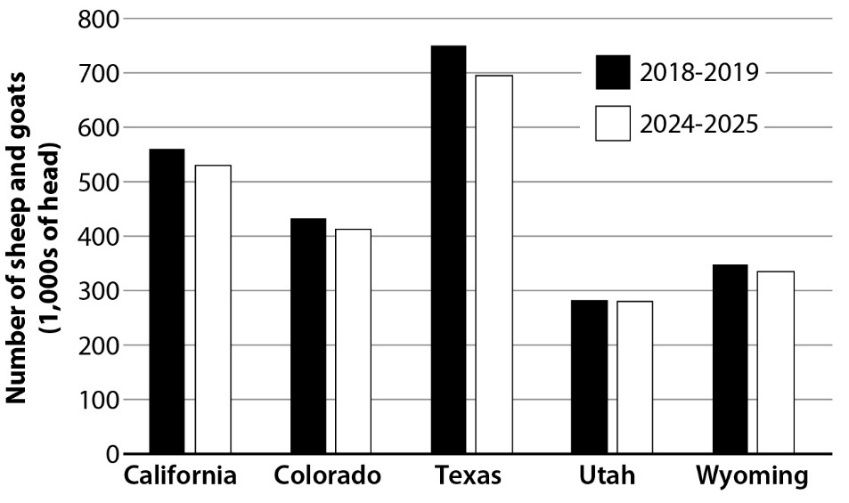
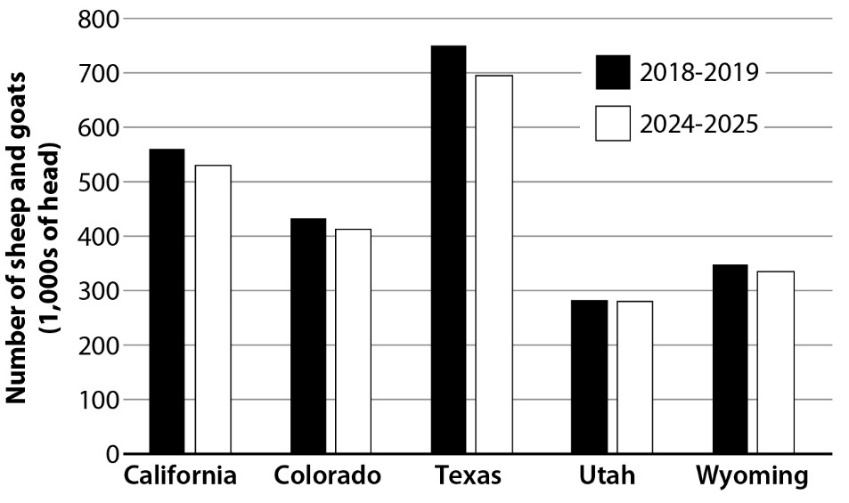
There are more data on sheep than goats. According to USDA data, the top five sheep states — Texas, California, Colorado, Utah, and Wyoming — account for about 45% of the 5 million U.S. sheep and lambs. Sheep numbers have been declining in these top five states and in the United States overall over the last 5 years (fig. 1).
The value of California lambs and goats sold for meat is less than $70 million a year. Receipts from wool, cheese, and vegetation management are not reported, but may add another $70 million in farm revenue, mostly from vegetation management services (perhaps 100,000 acres grazed at an average of $500 per acre per year, as reported by most California ranchers in our interviews), making sheep and goat industry revenues less than 1% of California’s $60 billion in farm sales.
Sheep and goats are ruminants with four-chambered stomachs that allow them to consume poor-quality forage. Sheep are more likely to consume herbaceous vegetation including grasses and broad-leaf plants, while goats are effective consumers of shrub species in addition to many weeds. Many vegetation management businesses have both sheep and goats to consume a broad spectrum of vegetation.
In a quest for low-cost forage, many sheep and goats spend part of each year on open rangeland, defined as land that is not cultivated because it has poor soil, is rocky, or otherwise unsuitable for crop farming. Poor-quality vegetation means that ranchers need large acreages to provide adequate forage for their animals. The federal government uses animal unit months (AUMs) to charge ranchers who graze animals on public range lands: one AUM is five 200-pound sheep or one 1,000-pound cow, plus their lambs and calves, and ranchers pay $1.35 per AUM to graze on federal lands in 16 western states including California; this is significantly less than the fees charged to ranchers who graze animals on private rangeland and cropland with higher quality forage such as alfalfa stubble.
Targeted grazing for vegetation management is a service business that uses animals to consume both grasses and brush that could burn in wildfires. Clients pay targeted grazers an annual fee of $100 to $1,500 an acre to cover the cost of transporting animals, herders, and dogs as well as temporary fencing, water, supplemental feed, and other inputs such as salt and veterinary supplies to the grazing site. Targeted grazing fees are highest in urban areas where mechanical or chemical removal of grasses and weeds is difficult due to the terrain or the proximity of homes.
There are limited data on targeted grazing, but industry observers believe that a minority of the state’s sheep and goats are involved. The major clients for targeted grazing services include federal and state agencies as well as local fire, park, and school districts, utilities and solar farms, orchards and vineyards, and homeowners’ associations (Schohr 2021). Many clients issue requests for bids and award contracts to the business that satisfies bid criteria at the lowest cost. Targeted grazing businesses assess the site, noting the type and quality of vegetation, ease of access, availability of water, and factors such as nearby encampments and domestic dogs that affect costs, and receive 1- to 5-year contracts to provide vegetation management services.
Herders and wages
Herders protect and move animals, ensure that they have feed and water, assist with births and sick animals, and feed the dogs that help to move and guard sheep and goats. Over 90% of California’s sheep and goat herders are H-2A visa holders; the others, often supervisors, are ex-H-2A workers who have become lawful permanent residents and sometimes naturalized U.S. citizens.
Range herders stay with their herds, living in mobile trailers that include toilets and showers, stoves and refrigerators, and sleeping facilities. Herders are on call 24/7, which means under California law that herders must be paid for 168 hours a week; our interviews found that most “work” 7 to 8 hours a day or 50 to 60 hours a week. However, unlike personal attendants who live with the clients they care for, range herders do not have designated off-duty time and normally cannot leave their workplaces.
Federal and state regulations establish minimum standards for the trailers that ranchers must provide to herders at no cost. Some trailers are modern camping-style units, while others are more traditional sheep trailers with fewer amenities. Low-cost forage is often in remote areas, so herders may be isolated, receiving a weekly visit from a rancher or camp tender who does a wellness check and brings fresh food.
Ranchers have long complained of too few herders. A 1950 University of California report noted that, despite a 50% drop in the number of California sheep between 1942 and 1950, “there has been a persistent shortage of skilled sheep labor in some areas” (Voorhies and Rudd 1950). In response to labor shortage complaints, federal legislation enacted in the early 1950s granted immigrant visas to “aliens skilled in shepherding.” Ranchers created the Western Range Association to recruit herders, mostly from the Basque region of northern Spain, and Basque herders were admitted without a test of the U.S. labor market to determine whether domestic workers were available or whether the presence of foreign herders had any adverse effects on American workers (Saitua 2024).
Some Basque herders switched to other jobs soon after arrival, which they could do as immigrants; many current sheep ranchers are descendants of Basque herders who settled in the United States. A January 14, 1957, report of the House Judiciary Committee (U.S. House of Representatives 1957) concluded that admitting herders born outside the United States as immigrants did not permit the sheep industry to “fully benefit” from their services, prompting a change to admit foreign herders as guest workers with 3-year contracts under the H-2 (H-2A after 1987) program.
Today, less than 5% of the 320,000 H-2A visas issued each year go to workers employed in animal agriculture, but half of these H-2A animal workers are open range herders (Castillio et al. 2021). The concentration of H-2A workers in crop production, rather than in animal agriculture, is not surprising because crop farming is generally more labor intensive and offers a higher share of seasonal jobs (Zahniser et al. 2025). Reliance on H-2A herders reflects path dependence over decades and federal policies that accommodated the sheep and goat industry’s reliance on range herders born outside the United States.
DOL developed special regulations for open-range herders in 1989 and required them to be paid a minimum monthly wage of $750 without providing a methodology. This minimum monthly wage, or Adverse Effect Wage Rate (AEWR), remained at $750 a month until the Mendoza v. Perez court decision in 2014 prompted new DOL regulations on November 16, 2015, that doubled the AEWR from $750 to $1,507 a month over a several-year phase-in period for herders who spend at least half of their time on the open range.
DOL’s methodology for the $1,507 monthly wage was based on the federal minimum wage of $7.25 for a 48-hour week. DOL converted the resulting $348 weekly wage to a monthly wage by assuming 4.33 weeks a month. The federal minimum monthly herder wage is adjusted each year to reflect the change in the Employment Cost Index for private sector wages and salaries during the previous year and was $2,058 in 2025.
California has a higher wage for range herders. Worker advocates surveyed herders in the San Joaquin Valley in 2000 and found that many lacked potable water, refrigeration to store perishable food, and access to transportation. They urged the Industrial Welfare Commission (IWC) to eliminate the herder exemption from the California minimum wage. Instead, the IWC held hearings on the adequacy of the state’s then $900 a month minimum herder wage and increased it to $1,200 after July 1, 2002, with subsequent increases determined by state minimum wage increases so that the minimum herder wage was $1,956 a month by 2018.
AB 1066, enacted in 2016, phased in overtime pay for farm workers and raised the alternative minimum monthly wage for range herders to $2,933.51 in regular wages plus $1,886.91 for overtime, or a total of $4,820.42 in 2025. To put the alternative minimum monthly wage in context, the herder wage is about:
-
$2,000 a month more than the earnings of a worker who earns California’s minimum wage of $16.50, which translates to $660 for a 40-hour week or $2,857.80 a month (assuming 4.33 weeks/month and 40-hour work weeks, without any overtime wages).
-
$1,500 a month more than H-2A workers who are paid the AEWR of $19.97, which translates to $798.80 for a 40-hour week or $3,458.80 a month (again assuming 4.33 weeks/month and 40-hour work weeks, without any overtime wages).
In our interviews, California ranchers reported that their range herders are very satisfied with wages and working conditions. Consultations with advocates, by contrast, featured assertions that ranchers often violate labor laws and H-2A regulations, but herders are afraid to complain for fear of being fired and blacklisted. It is very hard to evaluate these competing claims. For example, some advocates we spoke with said that many herders pay unlawful recruitment fees in their country of origin to get an H-2A visa to work in the United States, but there are no receipts for such payments, making it difficult to prove or disprove whether fees were paid.
There have been 12 completed DOL investigations of California sheep and goat farms since 2010, and they found 43 workers who were owed an average $3,500 in back wages (table 1). DOL assessed an average $10,000 in civil money penalties (CMPs) on California ranchers who violated labor laws and H-2A regulations. California had the fewest back-wage cases but the highest average CMPs among the top five sheep states, while Colorado had the highest average back wages owed to herders.
Like federal agencies, California enforcement agencies receive few complaints from herders. Between 2018 and 2024, there was one report of a labor law violation filed with the Labor Commissioner’s office potentially involving herders, but no individual wage cases were filed by herders nor investigations completed that resulted in Labor Commissioner findings of violations on sheep and goat farms. The Division of Occupational Safety and Health (DOSH or Cal/OSHA) assessed penalties of less than $10,000 each after six accidents that resulted in injuries on California sheep farms since 2015, including accidents that involved herders dying in all-terrain vehicle accidents or from heat stress.
Adjusting to higher wages
California ranchers say they cannot afford to pay twice the federal minimum monthly herder wage of $2,058 in 2025 or a third higher than the typical $3,500 monthly earnings of hourly H-2A workers who pick strawberries or harvest lettuce. The ranchers’ first reaction to overtime and the alternative minimum herder wage was to request that range herders be exempt from overtime wage requirements. SB 801, which would exempt sheep and goat range herders from AB 1066 overtime requirements, did not receive a vote in 2025 but is eligible for reconsideration in 2026.
A second approach would have ranchers and other farm employers pay overtime wages to farm workers and receive a state tax credit, as in Oregon and New York. Farmworkers do not have federal or state income taxes withheld from their earnings unless they and their employers agree; SB 628 would have reimbursed California farm employers for overtime wages up to the amount that was withheld from employee wages for state personal income taxes (PIT). California range herders earn $58,000 a year, including 39% or $22,560 in overtime wages, and owe about $2,300 in state PIT. If this $2,300 was withheld, SB 628 would have refunded $2,300 to the employer. However, SB 628 was not approved by the Senate Labor Committee in 2025 and failed as SB 921 in 2026.
A third response is to give sheep and goat ranchers credit against overtime wages to reflect the cost of housing and food they provide to herders. AB 241, which sets minimum wages for personal attendants who live with the clients they care for, anticipates that caregivers work 9 hours of work a day 7 days a week for a 63-hour work week. Overtime wages for personal attendants are required only for the 18 hours they work on the sixth and seventh consecutive days.
At the 2025 minimum wage of $16.50 for regular hours, and $24.75 for overtime hours, personal attendants earn $5,144 a month. Their employers are allowed to deduct $1,100 a month for room and board, making the net cost of a live-in personal attendant $4,044 a month or $1,500 less than the approximately $5,500 a month in wages and the cost of housing and food for a range herder. H-2A regulations require employers to pay for range herder housing and food but do not require the payment of overtime wages. California could credit the value of the housing and food provided to herders against the overtime wages due herders.
A fourth response would be for ranchers to pay hourly wages. Employers of hourly H-2A workers must provide free housing that satisfies federal, state, and local standards, including hot and cold running water, flush toilets, and refrigerators and cooking facilities, and modern trailers have these same features as permanent or fixed-site housing. If ranchers bought modern trailers for their herders and paid the hourly AEWR of $19.97 in 2025, herders would earn about $800 for a 40-hour week or $3,460 a month (4.33 weeks). As hourly workers, herders would track their hours worked and pay for their own food.
Modern trailers and hourly wages pose a tradeoff for ranchers and herders. If ranchers do not have modern trailers, they would have to spend $25,000 to $30,000 for each new trailer and pay overtime wages or develop another means to respond to emergencies. Herders would have better housing but earn up to $1,500 a month less.
Alternatively, ranchers could develop a hub-and-spoke system, grouping herders and their trailers at one location, paying hourly wages, and having one herder on duty while the others were off duty. H-2A regulations allow ranchers to house herders four to a room in a motel or other public accommodation and provide them with vehicles to drive to flocks, with one herder on duty while the others are off duty. Camera-equipped drones could allow remote monitoring of flocks and create a record of predators and intruders for insurance and other purposes (Yaxley et al. 2023).
There are other possible adaptations to higher herder wages. Australia, the largest exporter of lamb and goat meat, has a far less labor-intensive sheep and goat industry — one worker manages 3,000 to 5,000 sheep with the help of dogs and drones that monitor and move animals to fresh forage within large, fenced paddocks in areas with fewer predators than in the United States (Chaplain 2024). Australian ranchers use less labor because of their infrastructure and because they do not help ewes with births. USDA reports that Australian leg of lamb was imported to the United States in 2025 for $6 a pound (Free on Board, or FOB, price), half of the price that U.S. ranchers say they need to cover their costs.
California rancher responses to the increase in the minimum monthly herder wage are still unfolding, but several stand out. First, ranchers are responding with consolidation. Ranchers with favorable leases on public and private lands can sell their animals and leases to expanding ranchers, some of whom have more than 10,000 animals and can achieve economies of scale. The Census of Agriculture reported that California had 3,100 sheep farms in 2022, but the 29 with 5,000 or more animals included 62% of the state’s 532,000 sheep and lambs.
Second, ranchers are responding by increasing herd sizes. When herder wages were lower, ranchers often assigned 750 to 1,000 sheep to each herder. As herder wages rose, ranchers assigned more animals to each herder, sometimes 1,500 or more. The result is less intensive flock management, so that herders may need more time to identify and treat sick animals or assist with births, moving the California industry toward the lower-input and lower-cost Australian model.
Third, some ranchers are finding ways to compensate herders with hourly wages. The stereotypical herder is alone in the mountains with a trailer, dogs, and a flock of sheep. However, many California sheep and goats are near urban areas, so herders could live in permanent housing and commute daily to flocks. Hourly wage herders are paid a lower AEWR and must pay for their own food, which lowers labor costs. Under hourly wage systems, ranchers and domestic or non-H-2A workers would have to handle emergencies, or the H-2A herders would have to be paid overtime wages.
Fourth, ranchers are finding new revenue streams, most often through targeted grazing. Sheep and goats have traditionally been raised for meat, wool, and milk. Stagnant U.S. consumption of about a pound of lamb per person per year, wool prices that barely cover shearing costs, and a limited market for specialty cheeses, have combined to encourage some ranchers to switch from producing sheep and goats for meat to earning fees from clients as their animals help to manage vegetation. Targeted grazing providers often continue to sell meat and wool, but income from dedicated targeted grazing service providers can be more than three-fourths of their total revenue. Most ranchers believe that they must provide targeted grazing services to justify ranching in California.
California’s higher minimum monthly wage has not attracted more U.S. herders. There are many reasons for few domestic herders, including that the current workforce recruitment system, which relies on current H-2A herders recommending friends and family from their home countries as new H-2A herders, provides access to more experienced workers than are available in the United States. Most ranchers require at least 3 months of commercial herding experience, but few provide training. Several California colleges and universities have flocks of sheep and goats and offer courses, but most animal agriculture students want to become veterinarians or ranchers rather than herders. Training U.S. herders would likely require ranchers to specify required skills and cooperate with extension services and community colleges to develop herder certificate and apprenticeship programs whose credentials are recognized by ranchers.
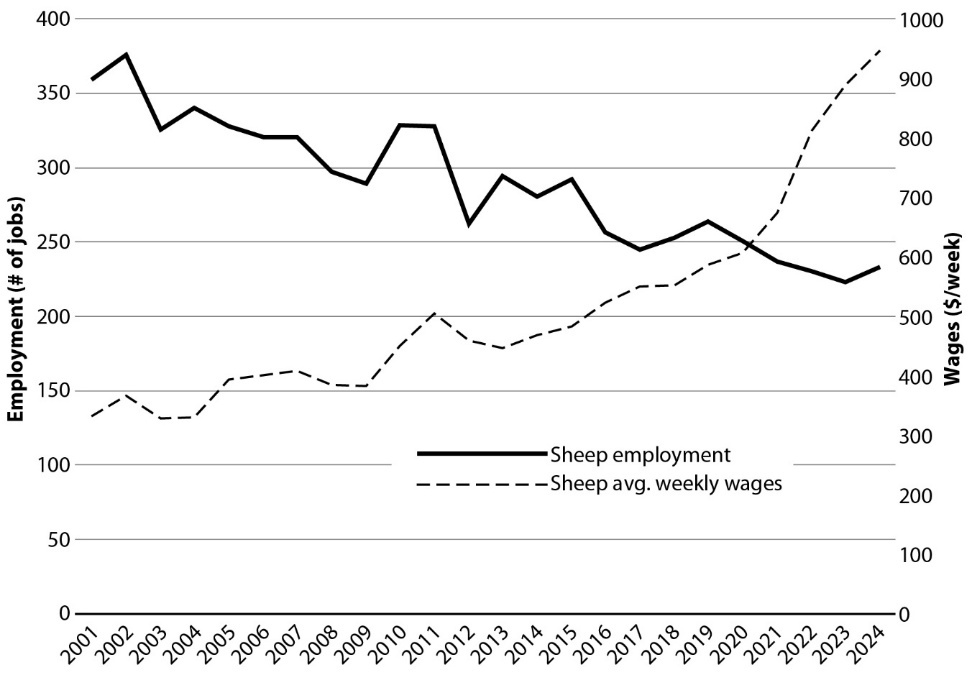
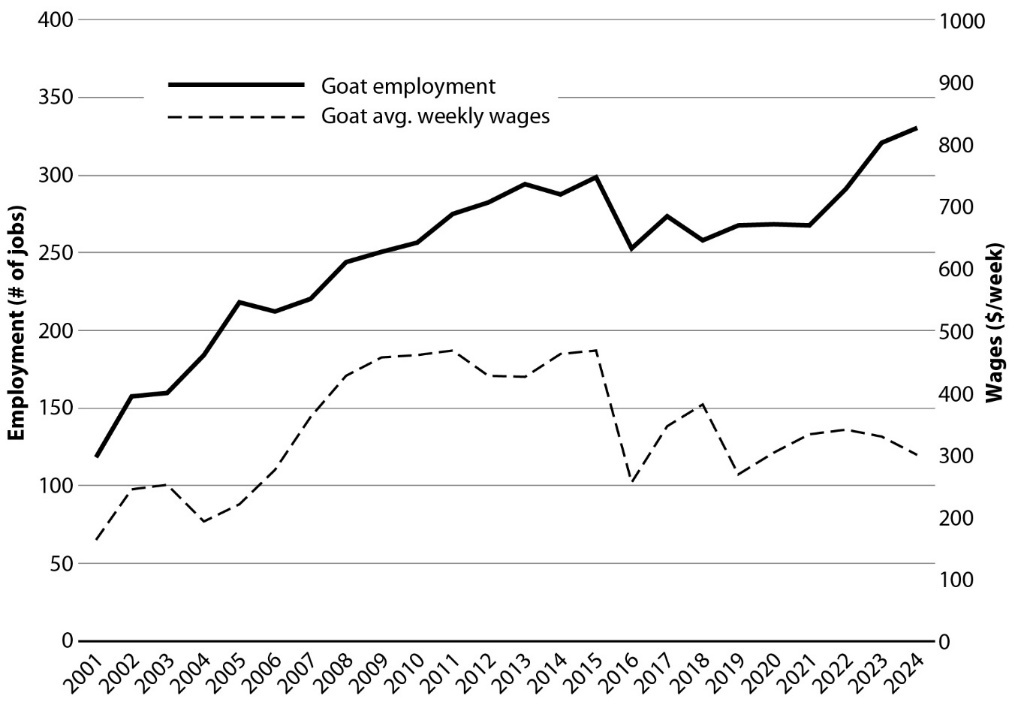
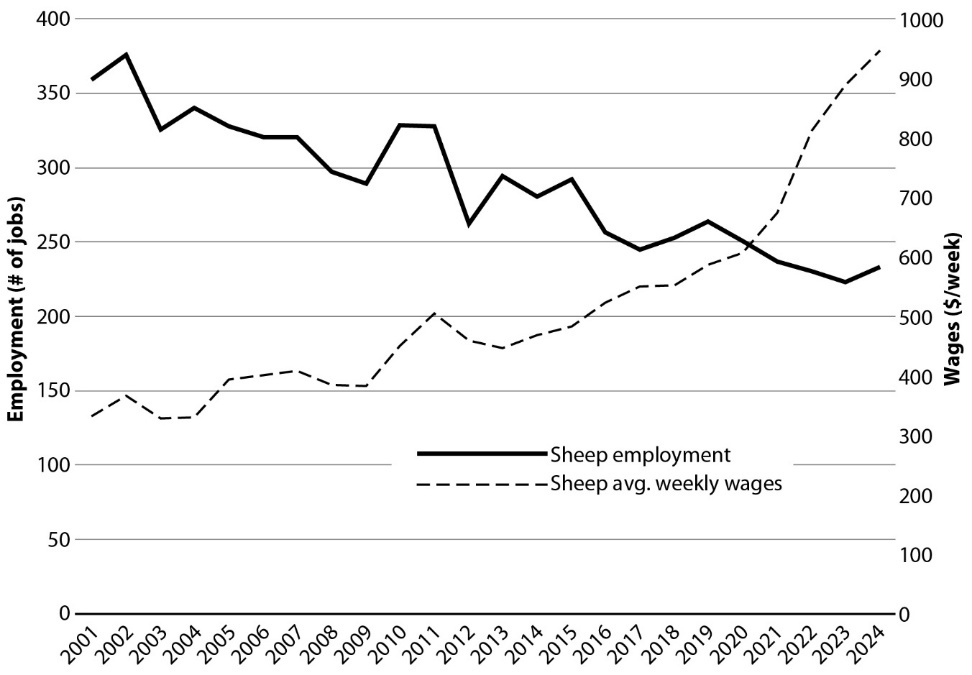
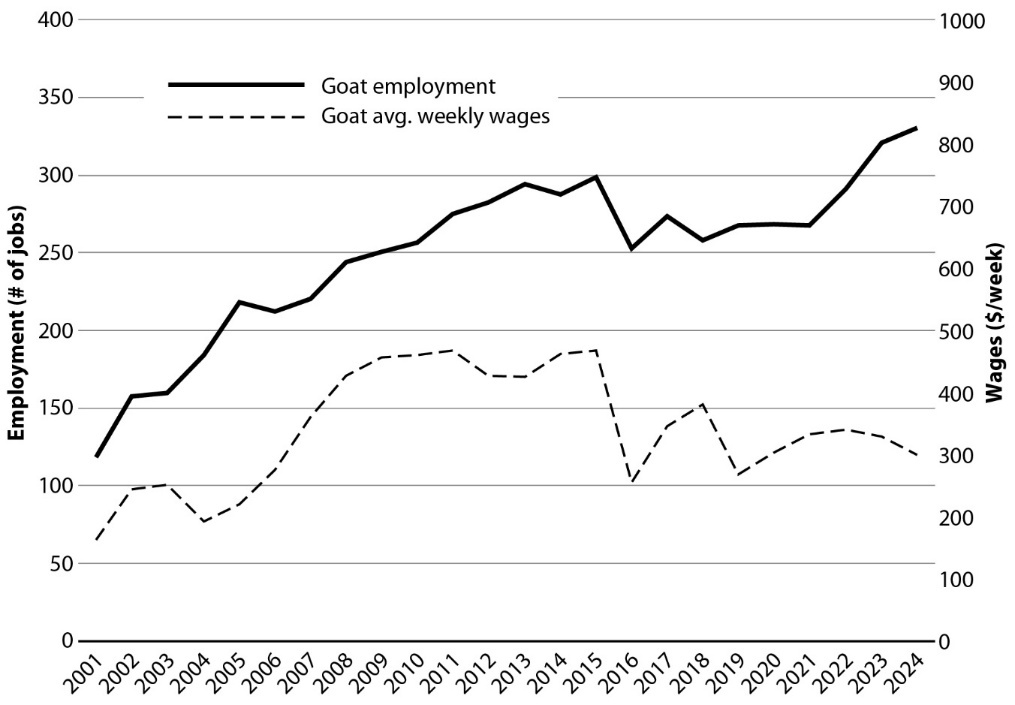
Some of the adjustments to rising herder minimum wages are apparent in average sheep and goat employment and wage data. Average sheep employment has been falling faster than the number of sheep and lambs in California, which suggests more animals per herder, while average sheep weekly wages rose sharply after 2019 (nominal) (fig. 2). Average goat farm employment tripled between 2001 and 2011, and remained high until 2015, but has since fallen by a third, while weekly goat wages rose after 2021 (fig. 3).
Conclusions
California mandates more-than-federal labor protections to farm workers, as exemplified by the Agricultural Labor Relations Act of 1975, which granted farm workers union rights, and AB 1066, which requires overtime wages for farm workers on the same basis as nonfarm workers. The Legislature will consider the future of the alternative minimum wage for range herders in 2026, including whether to have the same alternative minimum wage for sheep and goat herders.
Meanwhile, the sheep and goat industry has been adjusting to California’s higher-than-federal minimum range herder wage by consolidating into fewer and larger farms, assigning more animals to each herder, and shifting to hourly wages when feasible. Younger ranchers and new entrants see the future of the California sheep and goat industry as a service business that provides clients with animals to manage vegetation. This change from producing meat and wool to using sheep and goats for vegetation management mirrors changes in the beekeeping industry, which now earns most of its revenue by providing pollination services rather than by producing honey.
What lessons do sheep and goat adjustments hold for other commodities? The three major responses to higher labor costs are MMI:
-
Mechanization to replace workers and mechanical aids to make hand workers more productive
-
Migrant H-2A workers, often the most productive workers in their countries of origin and willing to work hard in the United States for much higher wages than they could earn in their home countries
-
Import labor-intensive commodities from lower wage countries
These MMI responses are visible in the sheep industry as California ranchers assign more animals to each herder and begin to provide them with technology to increase productivity, such as drones equipped with cameras to monitor larger flocks. Almost all range herders are H-2A migrants who arrive in the United States ready to work with commercial flocks or return to their previous rancher, demonstrating the value of experienced and productive workers.
Three-fourths of the lamb consumed in the United States is imported, and almost all imported lamb is from lower-cost producers in Australia and New Zealand. With few prospects for higher U.S. lamb prices, California ranchers are shifting their focus from producing meat to providing animals for vegetation management, the source of three-fourths or more of their revenue.
The public policy question is how to regulate herder wages in a sheep and goat industry with subsectors that are evolving differently. The same higher wages that accelerate the decline of the meat subsector are levelling the playing field for targeted grazing service providers. Targeted grazing funded by taxpayers may require grazers to satisfy both regular labor laws and additional labor standards, much as contractors who undertake publicly funded construction must satisfy prevailing wage and other requirements, so that clients with fixed budgets may pay for higher herder wages in the form of fewer acres grazed.
Phasing in regular or 8/40 overtime wages for California farm workers after 2019 accelerated changes that were already underway in agriculture generally and in the sheep and goat industry in particular. Higher labor costs accelerate consolidation, mechanization, and more reliance on productive migrant workers. A major adjustment in the sheep and goat industry is the shift from producing animals for meat to providing animals for targeted grazing services.
Acknowledgments
The authors acknowledge support for the SB 143 California Sheepherders and Goat Herders Study project under S24OD004 and thank the ranchers, herders, and other stakeholders who provided perspectives on the effects of overtime wages on herders and the sheep and goat industry.
California overtime wage laws require employers to pay 1.5 times (1.5x) the employee’s regular wage after 8 hours of work in a day and for the first 8 hours on the seventh consecutive day of work. After 12 hours a day for the first 6 days, and after 8 hours on the seventh consecutive day, on-duty employees must be paid two times (2x) their regular wage. This means that a worker on duty 24/7 who earns the state’s minimum wage of $16.50 in 2025 is due: $16.50 x 40 hours = $660 for regular hours; $24.75 x 32 hours = $792 for the 1.5x hours; $33 x 96 hours = $3,168 for the 2x hours. Combined, this means that a 24/7 minimum wage worker earns $4,620 a week and, for 4.33 weeks a month, $20,005 a month.
AB 1066 mandated a phase-in of 8/40 overtime wage standards for all agricultural workers, replacing the previous requirement to pay overtime wages after 10 hours a day or 60 hours a week to 8 hours a day or 40 hours a week in 2025. More information on AB 1066 can be found in Hill and Tanabe (2023).