Since 2016, California’s Healthy Soils Program (HSP) has allocated more than $162 million from cap-and-trade proceeds through California Climate Investments to improve soil health and sequester carbon (C). Program funding has supported both grower adoption of practices such as compost application, reduced tillage, and cover cropping, and demonstration projects evaluating these practices in California cropping systems.
By minimizing soil organic carbon (SOC) loss associated with tillage and adding organic C from external inputs and plant biomass grown in situ, HSP practices increase soil C storage and help mitigate climate change (Kӧgel-Knabner et al. 2023). However, soil microorganisms also produce the potent greenhouse gas (GHG) nitrous oxide (N2O) (Butterbach-Bahl et al. 2013). For practices that affect nitrogen (N) cycling, such as fertilization, tillage, and irrigation, the balance between changes in SOC and N2O emissions needs to be considered (Verhoeven et al. 2017).
California agriculture faces increasing challenges from climate change, including more frequent and severe drought and rising input costs. In addition to mitigating climate change, HSP practices can improve soil structure, fertility, and microbial activity (Lazcano et al. 2020). Soil health, defined as the soil’s ability to provide these services, can help manage extreme weather, drought, fertilizer costs, and disease, all of which are expected to increase with climate change. Therefore, soil health management is a key strategy for both climate change mitigation and adaptation.
While many studies on HSP practices focus on cereal cropping systems in temperate climates (Karlen et al. 2019), California’s Mediterranean climate and diverse cropping systems require tailored solutions. To address this, we conducted seven field trials in California’s Central Coast region. Here, we highlight lessons learned from these efforts. Note, it is not our intent to provide a comprehensive review of HSP practices or their global impacts, but rather to share region-specific experiences, outcomes, and take-home messages from field trials conducted in California’s Central Coast.
Overview of studies
The seven trials included vineyards, rangeland, dryland forage systems, and lemon orchards, with soil health and C sequestration metrics monitored for 2 to 3 years following practice implementation. Sites were selected to represent major agroecosystems, soil types, and eligible HSP practices, with site-specific practices and measurements determined primarily by landowner interest (table 1). Four trials took place on commercial operations and three on the working lands of California Polytechnic State University, San Luis Obispo. Practices evaluated included compost application, reduced tillage, cover cropping, and biological amendments, with vermicompost, vermicompost extract, and mycorrhizal inoculants only eligible for demonstration projects. Site characteristics and measured soil health indicators are summarized in tables 1 and 2. All trials were located in San Luis Obispo County, except for trial 3, which took place in Santa Cruz County.
Compost application: Source, rate, timing, placement, and soil characteristics matter
Compost source
When applying compost, the source, rate, timing, and placement need to be considered. Trial 1 compared dairy manure compost and vermicompost from similar feedstocks in a vineyard. After 2 years of practice adoption, vermicompost treatments showed higher organic matter, C, N, and C:N ratio, but lower pH, phosphorus (P), potassium (K), and sodium (Na) content compared to dairy manure compost under the vine, where compost was applied (Luck 2022). Manure-based compost is a viable alternative to synthetic P and K fertilizers, though excessive P can cause environmental degradation and excessive K can harm soil structure (Pernes-Debuyser and Tessier 2004; Sharpley et al. 1994). Compost chemical composition can vary, so evaluating test reports is recommended. Details on chemical composition of compost used in trials in this study are provided in previously published work (Luck 2022; Wilson et al. 2025; Wong et al. 2023).
Compost rate
Compost effects increased with rate but varied by soil and implementation. In Trial 2 (vineyard), annual compost applications ranged from 0 to 6 dry tons/acre, reflecting typical regional rates. Rates greater than 6 tons/acre raise grower concern for excessive vigor (C. Decock, personal communication with growers). Permanganate oxidizable C (POXC), an early indicator of soil C change (Christy et al. 2023; Hurisso et al. 2016; Woodings and Margenot 2023), increased with compost application rate, suggesting compost may be building soil C, even though total SOC was not detectably changed by the end of the trial (Wong et al. 2023). In Trial 3 (rangeland), a one-time compost application at 0, 10, 20, and 30 dry tons/acre showed significant improvements in soil health (soil C, POXC, water holding capacity [WHC], aggregation) at higher rates and on the older marine terrace with finer soil texture and more pedogenic development, but no effects on the younger terrace with sandier soil (Wilson et al. 2025). This indicates that compost effects depend on soil properties. In Trial 1 (vineyard), which evaluated the effects of diminishing rates over time, compost significantly increased soil organic matter (SOM), nitrate-N, P, and K in the second year (Luck 2022), but these effects disappeared when rates dropped to 1 dry ton/acre, suggesting that 2 dry tons/acre/year is necessary for measurable benefits (C. Decock, unpublished data).
Compost timing and placement
Timing of compost application varies among growers. We chose fall, so winter rains could move surface-applied compost into the soil. Depending on the C:N ratio of the compost, net mineralization or immobilization of N will occur, usually within the first month (Korsaeth et al. 2002). Mineralized N from low C:N ratio compost applied early in the season may contribute to the crop’s N requirement (Lloyd et al. 2022).
Compost can be banded or broadcast, then incorporated or left on the surface. In Trial 2, surface applied compost increased POXC to a depth of 2 feet across all application rates in a vineyard under long-term no-till management, suggesting incorporation isn’t necessary for deeper soil impacts. Broadcasting in Trial 2 showed effects in both the vine and drive row, while banding had limited effects to under-vine areas in Trial 1. Though roots grow well into the drive row (Smart et al. 2006), impacts of drive row soil health on vine performance are not well understood.
Tillage intensity: Optimize to balance benefits and tradeoffs
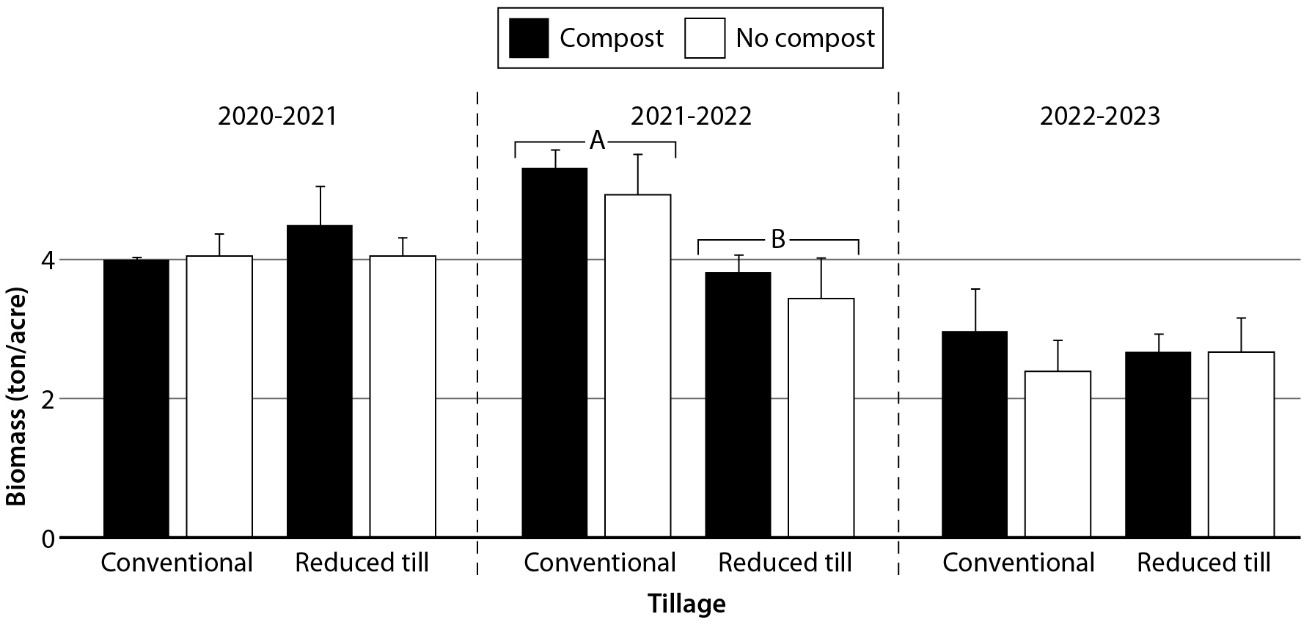
Tillage effects on soil health and C sequestration were evaluated in Trials 4 and 5. Trial 4, conducted in a dryland forage field, compared reduced tillage — using a single pass of an OPTIMIZER system (disk blades, reels, chisels, rollers) — to a control involving an average of four passes for seedbed preparation. While reduced tillage showed no significant impact on soil health indicators, it resulted in lower yields in the second of three growing seasons (fig. 1).
_in_the_2020--2021__2021--2022__and_2022--2023_season_.jpeg)
Trial 5, in a biodynamic vineyard, compared no-till to the grower’s practice of biannual tillage using a three-point offset disk. No-till had no significant effect on grape yield or quality (Lazcano et al. 2022a), but it slightly reduced CO₂ fluxes during the rainy season, especially in year 1, suggesting reduced carbon loss if carbon inputs were comparable between treatments. Although total soil C stocks remained unchanged, no-till increased POXC stratification, with higher concentrations in the topsoil.
The yield impacts of reduced or no-till practices vary across crops and regions, ranging from penalties to neutral or positive effects (Allam et al. 2021; Pittelkow et al. 2015). However, potential savings in labor and fuel costs may offset yield declines (Kim et al. 2006). Given the variability in tillage responses, optimizing practices often requires multiple trial iterations tailored to specific crop systems and environments (J. Mitchell et al. 2016; J. P. Mitchell et al. 2009). While this study observed minimal benefits of reduced or no-till to soil health and C sequestration within the first 2 to 3 years of practice adoption, long-term no-till adoption has shown positive outcomes in tomato-cotton rotations in California’s San Joaquin Valley (J. P. Mitchell et al. 2024).
Cover cropping: Species selection, growing conditions, and termination strategy interact
Trials 6 and 7 assessed the effects of cover crops in lemon orchards. Both trials compared the grower practice (control with no cover crop) with a triticale cover crop planted in the alley rows. Trial 6 also included a cereal-legume mix panted in the alley rows. No cover crops were planted under or around the trees. In Trial 6, alley rows were kept weed-free with the use of herbicides in the control treatment, while in Trial 7, resident vegetation — primarily Malva spp. — was allowed to grow in the control alley rows (Rodriguez-Paiatsyka et al. 2025).
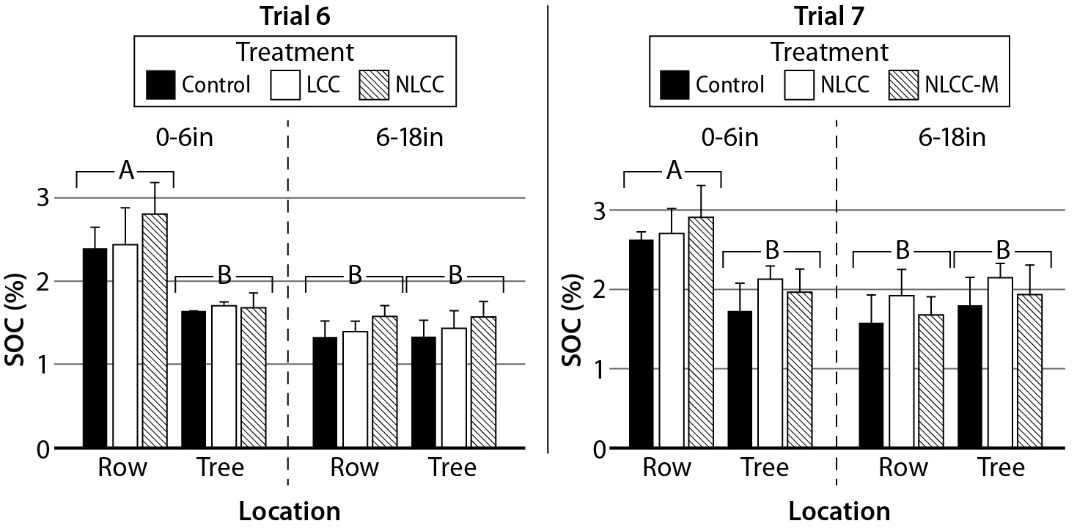
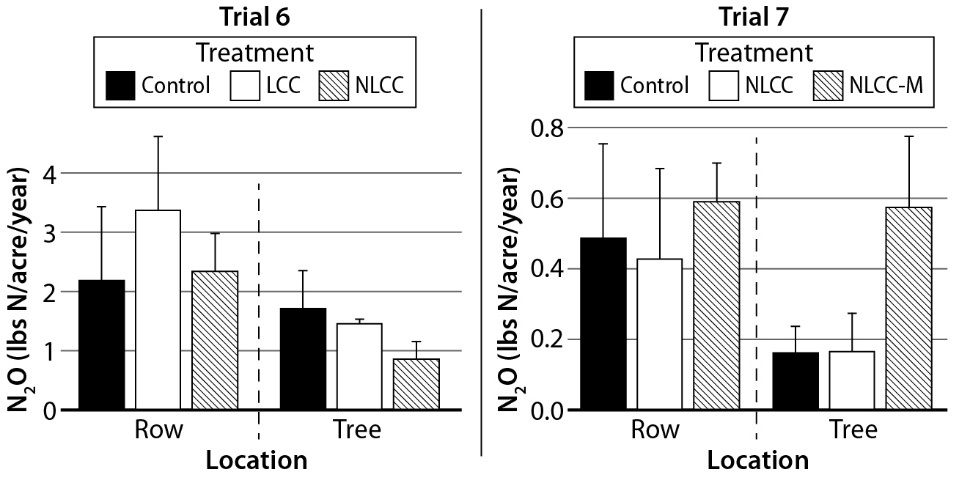
Over 2 years, cover crops had no significant effects on tree nutrition, soil C, N2O emissions, abundance of specific nematode feeding groups, or other measured soil health parameters (figs. 2 and 3, table 3, and unpublished data). These limited impacts may reflect low biomass from drought, poor legume germination (likely from soil compaction, mulch interference, and moisture stress), and the short duration of the trial. Additionally, weeds in the Trial 7 control treatment may have masked cover crop benefits, as some studies suggest that weeds can deliver similar ecosystem services (Yvoz et al. 2021).
_concentrations_at_the_lemon_orchards_in_the_middle_of_the_row_a.jpeg)
_emissions_at_the_lemon_orchard_trials_(left__tri.jpeg)
Impacts of cover crops on C sequestration and soil health are known to depend on species selection, productivity, growing season, and termination strategy (McClelland et al. 2021; Moukanni et al. 2022; Wauters et al. 2023). Cereal-legume mixes offer multiple benefits: legumes fix atmospheric nitrogen and, when combined with cereals, promote C sequestration through greater biomass production and enhanced microbial C efficiency (Moukanni et al. 2022). However, legumes may also increase N2O emissions (Basche et al. 2014). In addition, our data and a small side experiment (C. Decock, unpublished data) suggest triticale is more drought tolerant and better suited to compacted or poorly prepared soils than legumes.
Cover crops can be terminated using herbicides, by mowing, rolling/crimping, or grazing, each with or without tillage. Trial 5 compared mowing to sheep grazing in a vineyard. While grazing did not alter POXC or plant-available N, the combination of grazing and tillage led to higher soil nitrate levels and occasional increases in daily N₂O fluxes, which emphasizes the need to align termination strategies with management goals.
A concern in perennial systems is the potential competition for nutrients and water. In our lemon orchard trials, cover crops had no significant effect on soil or leaf nutrient concentrations, and most nutrients remained within acceptable ranges for citrus. Some studies suggest cover crops can enhance exchangeable cations and micronutrients via chelation and pH reduction (Demir et al. 2019; Sharma et al. 2018), but long-term effects in Central Coast citrus systems remain unclear. Water dynamics were not monitored in our trials. However, recent work shows that winter cover crops have minimal impact on soil moisture and evapotranspiration in California specialty crops (DeVincentis et al. 2022).
Although HSP practices showed limited short-term effects, consistent differences in soil health indicators between tree/vine and alley rows point to strong legacy effects of long-term management. In vineyard Trials 1 and 2, where compost was the primary treatment and cover cropping was well established, greater soil health in alley rows likely reflects cumulative vineyard floor management (Luck 2022; Wong et al. 2023). Similarly, in the lemon orchards, higher soil health in alley rows (fig. 3), including greater populations of predominantly beneficial nematodes and greater microbial biomass (Trial 7; Rodriguez-Paiatsyka et al. 2025), may be attributed to a long history of mulch application. These results underscore the importance of long-term practice adoption and the need to account for spatial variability in sampling design to accurately assess soil health outcomes.
Biologicals: A complicated market
Biological products are increasingly promoted as soil health management tools. Agricultural biologicals encompass a diverse range of products with varying modes of action, which makes broad conclusions about their effects on soil health challenging (Abbott et al. 2018). In this study, we evaluated two biological products: arbuscular mycorrhizal fungi (AMF) inoculum and vermicompost extract.
In Trial 7 (lemon orchard), we inoculated a cover crop with AMF to facilitate colonization and applied AMF for 3 years, but did not observe impacts on biomarkers for AMF abundance, cover crop growth, C sequestration, or plant nutrition (Rodriguez-Paiatsyka et al. 2025). Research showing positive AMF effects often involves controlled environments or assesses native AMF, not inoculation (Chen et al. 2018; Jeewani et al. 2021). In this field setting, high native AMF populations may have outcompeted the introduced strain. More research is needed to determine under what conditions AMF inoculation is effective.
In Trial 1, we evaluated the impact of vermicompost extract on C sequestration and soil health in an organically managed vineyard. No fertilizers or soil amendments were applied to the control treatment during the trial period. Applied through irrigation for 3 years, vermicompost extract showed no effects on GHG emissions, SOM, nutrient levels, or microbial community composition during the first two years (Luck 2022). In the third year, the vermicompost extract treatment showed a more uniform nitrogen and microbial distribution between the topsoil and subsoil, whereas these differed notably in the control (C. Decock, unpublished data). This suggests vermicompost extract may distribute microorganisms and nutrients more evenly within the root zone, though its impact on vine health remains uncertain.
Stacking practices
Most knowledge on soil health management comes from long-term trials that focused on single practices; such trials do not reflect the complexity of commercial crop production, where multiple practices are often combined in response to economic and environmental pressures (Ellis and Paustian 2024). Few studies assess the synergistic or antagonistic effects of stacked practices. In Trial 4, compost application in a dryland forage field increased P and K concentrations, but there was no added benefit from reduced tillage (fig. 1, unpublished data). In Trial 5, vineyard grazing increased N2O fluxes under conventional tillage, but no-till mitigated this effect (Lazcano et al. 2022b). These findings highlight the need for more research into impacts of stacked practices, with a focus on optimizing resource use to align with diverse grower goals.
Implications and knowledge gaps
Overall, the results from seven controlled field trials show that short-term impacts on soil health were limited. On the other hand, where measured, no increases in N₂O emissions were detected, which highlights the practices’ lack of environmental tradeoffs in the short term. Compost impacts varied by source, rate, timing, and soil properties, while cover crop impacts depended on species, management, and termination. Stacking practices did not consistently improve soil health and may have synergistic or antagonistic effects.
Our findings highlight the need for a systems-based approach tailored to crop, region, and grower needs. Crucially, improving soil health requires a long-term commitment, supported by long-term trials that assess benefits, tradeoffs, and return on investment, especially in the context of climate change.
Acknowledgments
This work was supported by California’s Healthy Soils Program and the California State University Agricultural Research Institute. We are grateful to the growers, ranch managers, and field staff who collaborated on field trials, as well as the many graduate and undergraduate students whose efforts contributed to these projects. We also thank the staff at Cal Poly San Luis Obispo and the Resource Conservation District for their invaluable support.