Across California each year, thousands of young people, ages 5 to 18, engage in hands-on learning through UC Cooperative Extension’s 4-H Youth Development Program. This reach is possible because adult volunteers serve as 4-H projects leaders where they plan and facilitate educational experiences in a specific subject area, creating a safe, supportive, and engaging learning environment. Subject areas cover a range of content areas from livestock to robotics, and all should be based on youth development research and education best practices. Volunteers identify, adapt, and facilitate curriculum into learning experiences for youth. These 4-H volunteer educators’ pedagogical design capacity shapes program quality and, ultimately, youth outcomes (Lewis et al. 2021; Smith et al. 2023; Worker 2017). Volunteer educator development is a key lever in enhancing program quality. Unfortunately, ineffective short, one-off, expert-led workshops remain common, even though ongoing and learner-centered approaches are more likely to improve educator practice (Schmitt-McQuitty et al. 2019; Smith 2013; Smith and Schmitt-McQuitty 2013; Smith et al. 2017).
In a recent needs assessment, California 4-H volunteers identified clear priorities for their own development, including strengthening curriculum and project-specific knowledge, program management basics, child development, and practical pedagogy (Kok et al. 2020). Volunteers favor peer-to-peer learning alongside online and in-person formats (Kok et al. 2020).
To meet these needs, the UC Agriculture and Natural Resources (UC ANR) Volunteer Workgroup developed an extension guide, created supplemental training materials, and launched a statewide virtual series using this supplemental training material to provide standard multi-part training to 4-H volunteers. These efforts were intended to meet volunteers where they are, build the skills they say they need, and elevate the quality of 4-H learning across the state. In this manuscript, we describe the development of these materials and the learning outcomes reported by adult 4-H volunteers who participated in the workshop series.
4-H Volunteer Educators’ Guide: Needs, frameworks, and practice
In 2016, the UC ANR Volunteer Workgroup conducted a statewide needs assessment of California 4-H adult volunteers to identify who serves, what roles they fill, and their training needs (n = 2,107; Go et al. 2018; Kok et al. 2020; Worker et al. 2020). The survey documented that most volunteers serve as project leaders and that many prepare for their roles via 4-H orientation (which is limited), and then their own personal previous experience (e.g., with K-12 formal education or career experiences). Volunteers often rely on self-developed (71%) or peer-shared (45%) curricular materials, underscoring the need for accessible, research-based resources (Go et al. 2018).
The workgroup began to update and expanded the long-used 4-H Project Leaders’ Digest (Chin et al. 2007) into a comprehensive, research-informed resource for today’s 4-H project leaders, guided by the needs assessment results, the UC 4-H Youth Development Program Framework (Dogan et al. 2012), and the 4-H Thriving Model of Positive Youth Development (Arnold 2018).
The updated publication, UC 4-H Volunteer Educators’ Guide: For Those Facilitating 4-H Educational Experiences (Marshall-Wheeler et al. 2023), retained core orientation content while adding evidence-based chapters on youth development and experiential learning. The guide orients adult volunteers to their educator role across multiple delivery modes, including community club projects, after-school clubs, day camps, and teens-as-teachers settings. The guide recognizes that volunteers plan sequenced meetings, invite guest speakers, and guide reflection so youth can apply learning to real contexts. The guide embeds developmental context practices emphasizing relationships, belonging, sparks (personal interests and passions that inspire motivation and purpose), and engagement. Complementary sections address ages and stages, 4-H terminology, program safety and insurance, online learning and digital communication, youth–adult partnerships, and practices for engaging youth leaders. Together, these chapters provide practical tools while aligning program delivery with research on high-quality youth development settings. See Appendix A online for a summary of each section’s content and informing literature.
Turning guidance into practice: Ready-to-use training materials
Upon completing the guide, the Volunteer Workgroup produced a suite of facilitation-ready training materials. Each guide section has a lesson that blends an experiential activity with facilitation strategies to help volunteers learn that respective guide section’s core ideas. Collectively, the supplemental materials operationalize the guide by giving 4-H professionals a consistent structure (objectives → experience → reflection → application), common artifacts (handouts, slides, and worksheets), and clear timing for each module. This approach supports fidelity across counties while preserving local flexibility in order, grouping, and delivery mode.
Each session used participatory, experiential methods. For example, in the youth–adult partnership training module (section 10), volunteers use a Hart’s Ladder “ladder walk,” and place real 4-H scenarios on rungs from tokenism to partnership and then rewrite one scenario to share power (e.g., co-planning agendas, youth-led demonstrations), which helps them learn how to move from adult-directed to authentic youth–adult collaboration. Locally, this equips project leaders to embed concrete steps, like youth co-facilitators, rotating decision items, or teen planning committees, so members have meaningful voice in their project.
Broadening access: Virtual training series
To broaden access and ensure implementation fidelity, the Volunteer Workgroup delivered a statewide online training series consisting of four live, 2-hour evening sessions per cohort, for a total of 8 hours. The series was offered five times with cohorts in September 2023, October 2023, March 2024, September 2024, and February 2025. Each session used the supplemental training materials, adapted for a virtual delivery. The design enabled participants to complete an integrated progression of foundational concepts, practical planning tools, and applied facilitation strategies, with opportunities to apply learning locally in their 4-H projects. Participants were not required to complete all four sessions and did not have to attend the sessions in order.
-
Session 1 focused on youth development foundations using the 4-H Thriving Model, including sparks, belonging, developmental relationships, and engagement. The session was facilitated by Gemma Miner, a volunteer engagement coordinator with expertise in youth development practice, and co-facilitated by Matthew Rodriguez, a 4-H Youth Development advisor with expertise in applied youth and family programming.
-
Session 2 addressed learning in 4-H, with emphasis on the experiential learning cycle and lesson planning. The session was facilitated by Steven Worker, a 4-H Youth Development advisor with expertise focusing on designing hands-on learning and translating experiential methods into practical lesson plans for project settings.
-
Session 3 concentrated on working with all ages and abilities, including ages and stages, engagement strategies, and activity types. The session was facilitated by JoLynn Miller, a 4-H Youth Development advisor with expertise in volunteer development, experiential learning, youth retention, and program planning.
-
Session 4 centered on youth–adult partnerships and the preparation and support of junior or teen leaders, with concrete steps for involving youth in leadership. The session was facilitated by Nicole Marshall-Wheeler, a 4-H Youth Development advisor with a focus on youth leadership, experience that underpins concrete practices for power-sharing, co-planning, and supporting teen leaders.
Exploring volunteer learning outcomes
We assessed learning from five cohorts participating in the four-session virtual workshop series where (1) true-pre was collected during registration, and (2) retrospective-pre and (3) post-test were collected after each live session.
Participants
Across the series, 307 unique individuals registered; 168 attended one or more sessions. Attendance ranged from eight to 48 participants per live session. By session, aggregated attendance totaled 133 for Session 1, 106 for Session 2, 98 for Session 3, and 95 for Session 4. Overall, 87 completed all four sessions, 14 completed three, 15 completed two, and 52 completed one. At registration, participants reported county, years of 4-H volunteer service, and the project areas they were likely to lead. A majority of participants were newer volunteers: 52% reported two or fewer years of service (median = 2 years; mean [M] = 4.5, standard deviation [SD] = 6.3). Post-session surveys were anonymous and were not linked to registration records, so usefulness ratings and learning gains could not be compared by years of service.
Measures
We assessed learning indicators aligned to session learning objectives. We collected registration true-pre ratings as a descriptive baseline, in addition to measuring retrospective-pre ratings and post-session ratings after each session to estimate self-reported learning. This approach can help address response-shift bias when participants recalibrate their understanding of program content (Hill 2020; Hwalek et al. 2024). Response options were 1 = No knowledge, 2 = Basic knowledge, 3 = Intermediate knowledge, 4 = Advanced knowledge, 5 = Expert knowledge (table 1). On the post-session survey, we also asked participants to rate perceived usefulness: “How useful was today’s session in your role as a 4-H volunteer educator?” (1 = Not useful to 5 = Very useful) as well as “What were the most important things you learned you plan to use in your 4-H projects?” and “What would help improve the session?”
Procedure
At registration, individuals completed the true-pre survey that included background questions and two knowledge indicators per session. After each live session, attendees received a Qualtrics link and completed a single instrument that combined the retrospective-pre and post ratings for that session’s full indicator set, plus the usefulness item and open-ended questions.
Data analysis
Analyses were conducted at the item level. For learning outcomes, we restricted inferential tests to matched cases within the post-session survey and compared retrospective-pre versus post means using two-tailed paired-samples t-tests. Unmatched cases and partials were dropped listwise within each comparison. We reported descriptive statistics (M, SD, n) at true-pre, retrospective-pre, and post for each indicator. For context, differences between true-pre and retrospective-pre were examined descriptively; because these samples are not matched (the post-session survey was anonymous), we treat true-pre as a baseline for registrants and retrospective-pre to post as the estimate of session-related change among attendees. For usefulness, we summarized ratings by session using the dataset’s session field and included only non-missing responses. For open-ended items, we conducted a rapid content analysis using a structured, keyword-assisted coding dictionary aligned to session objectives to group responses into themes and count mentions; brief example quotations illustrate each theme.
What volunteers reported learning
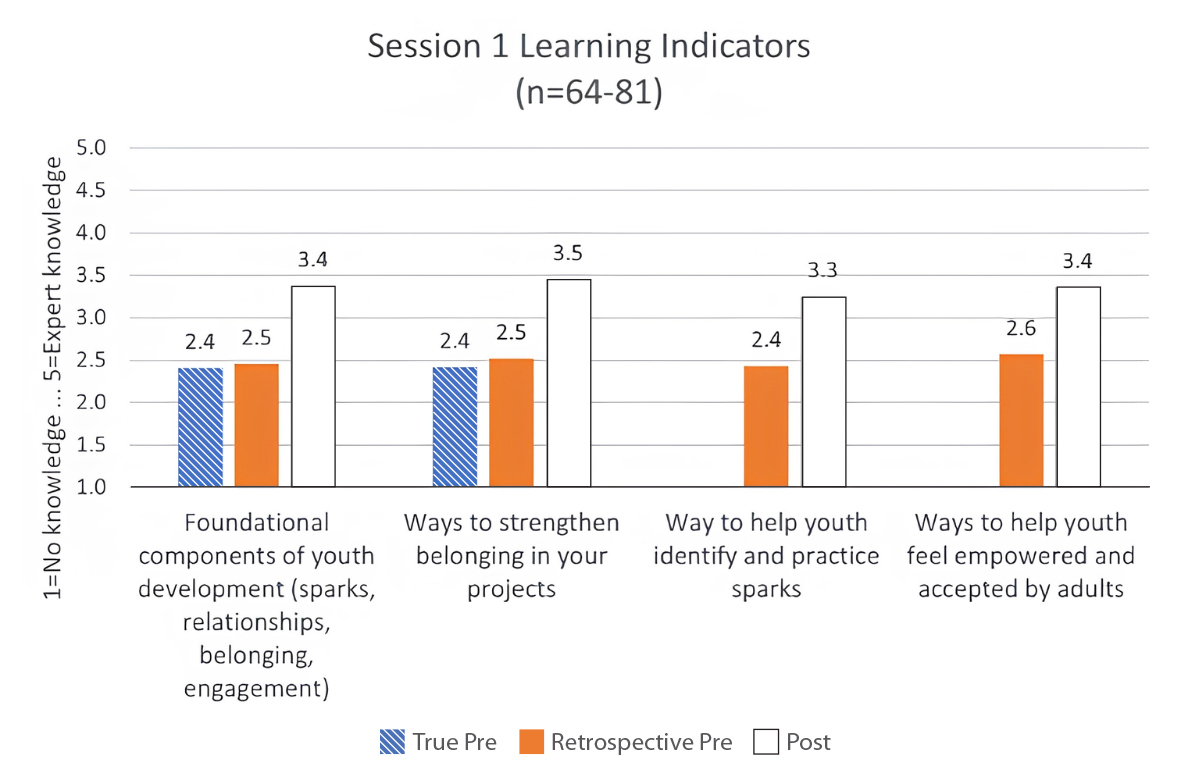
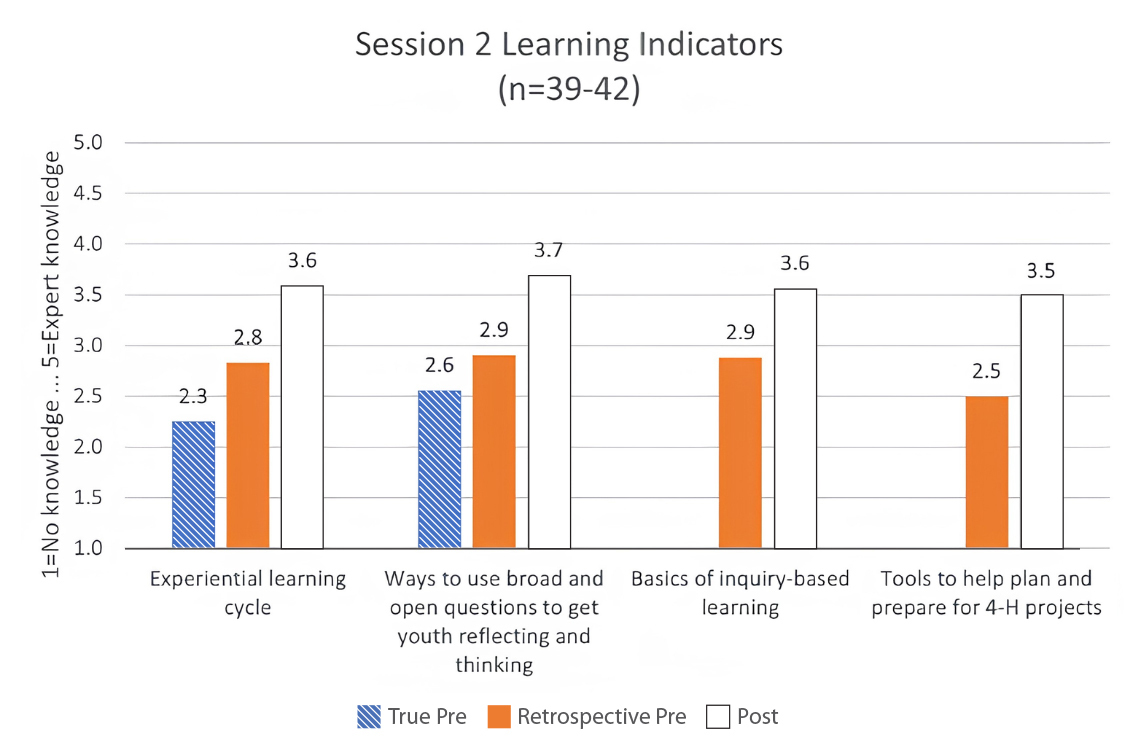
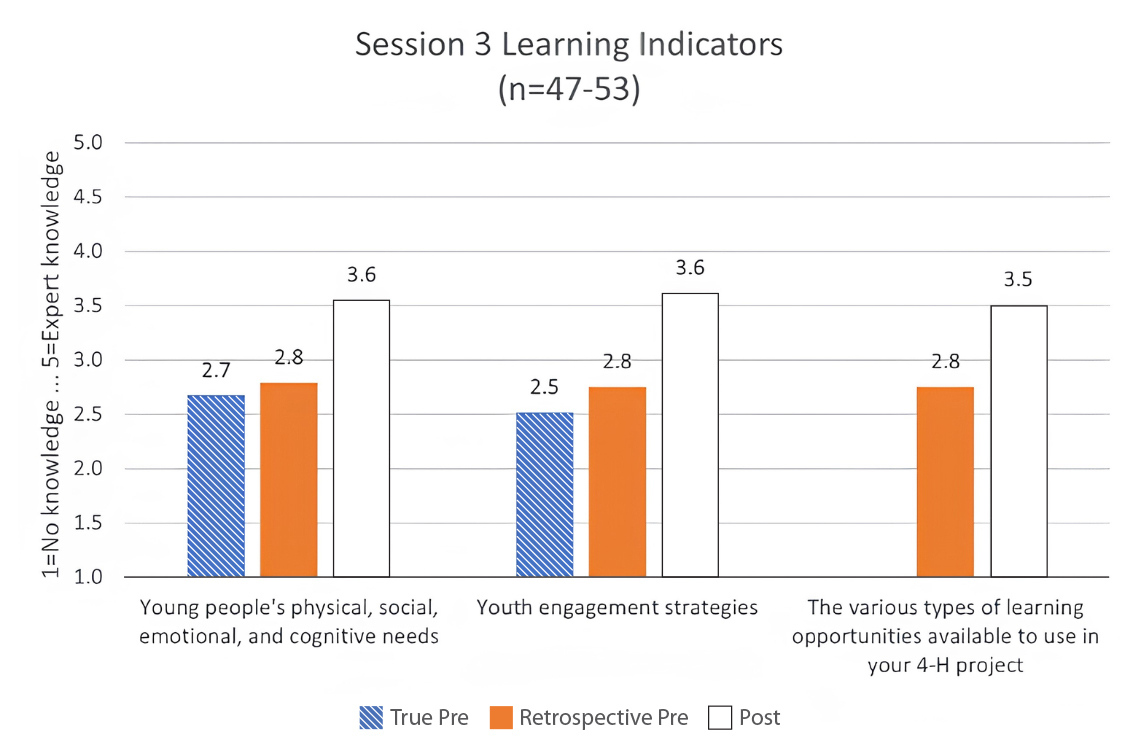
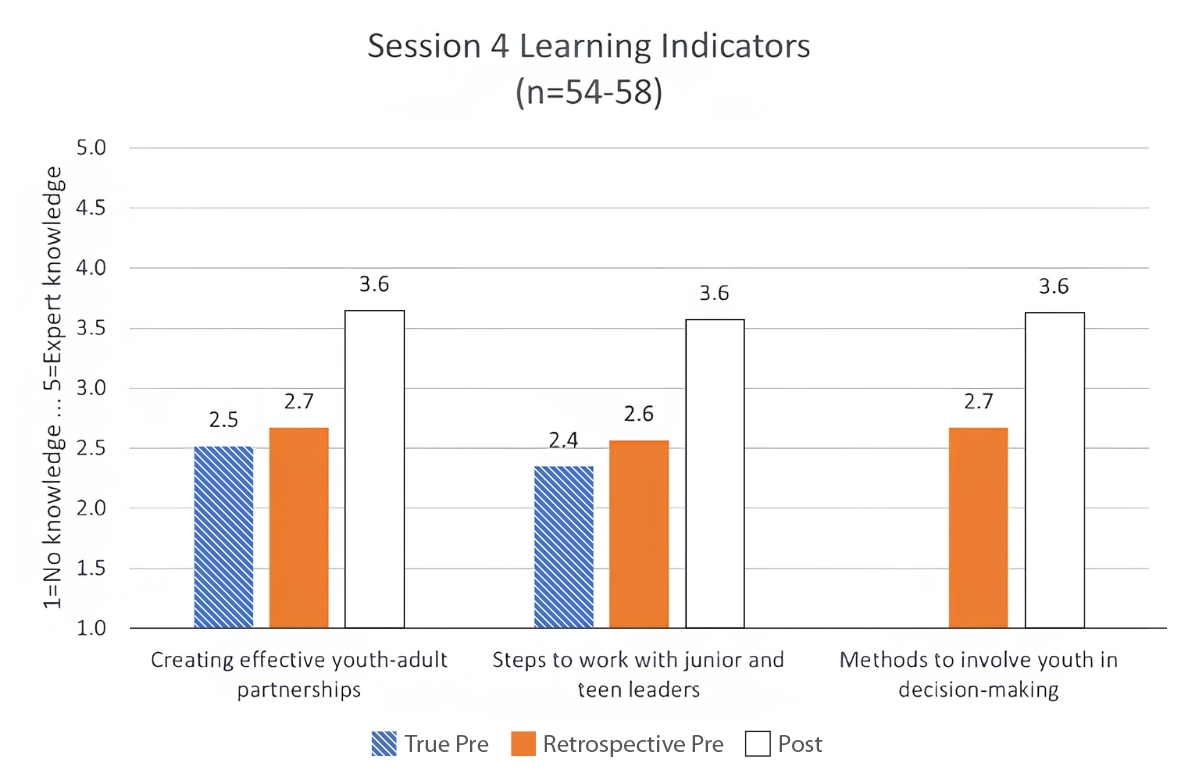
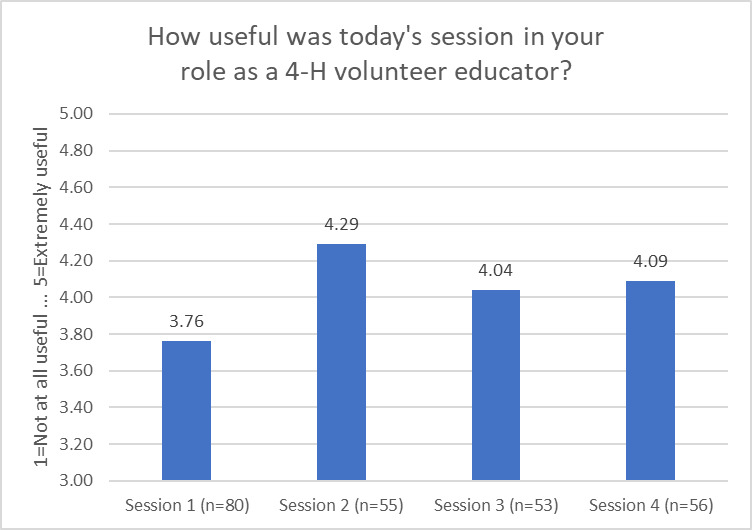
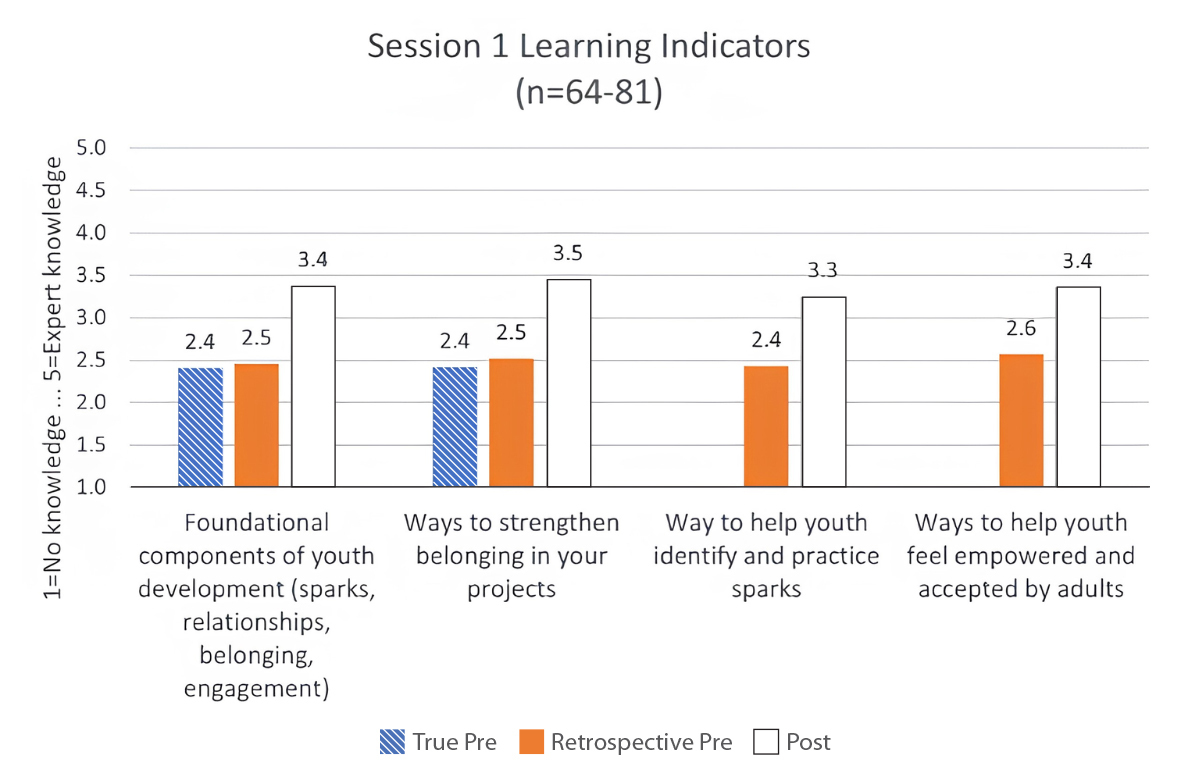
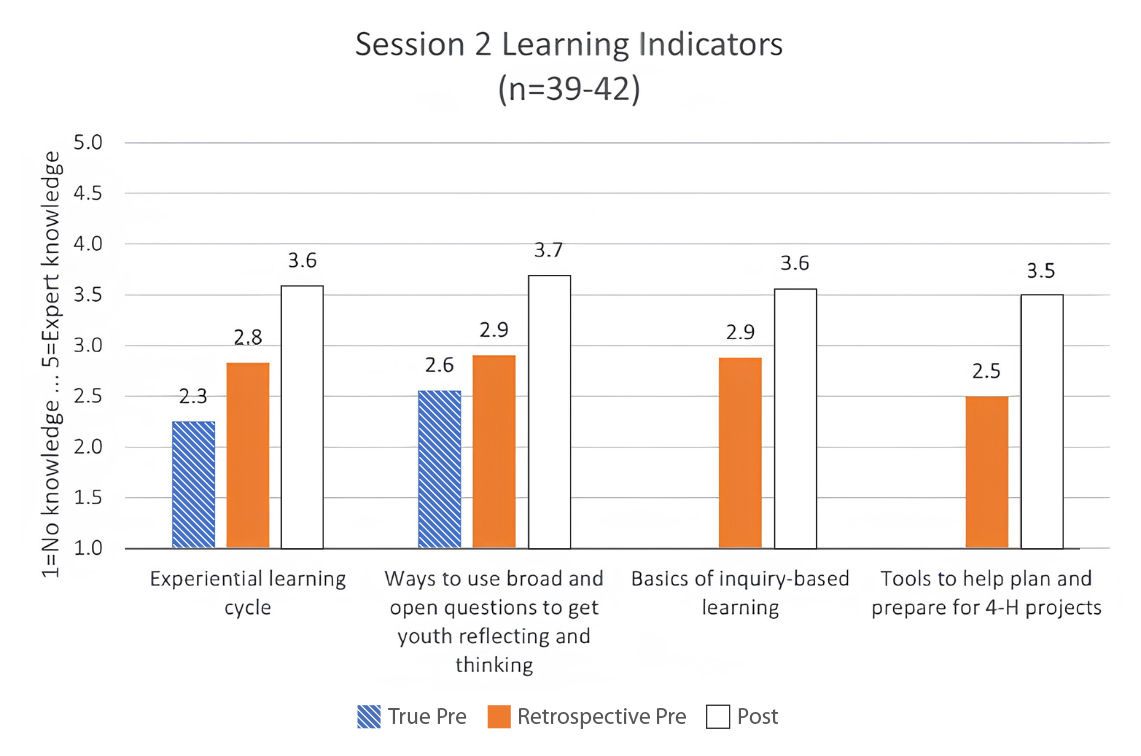
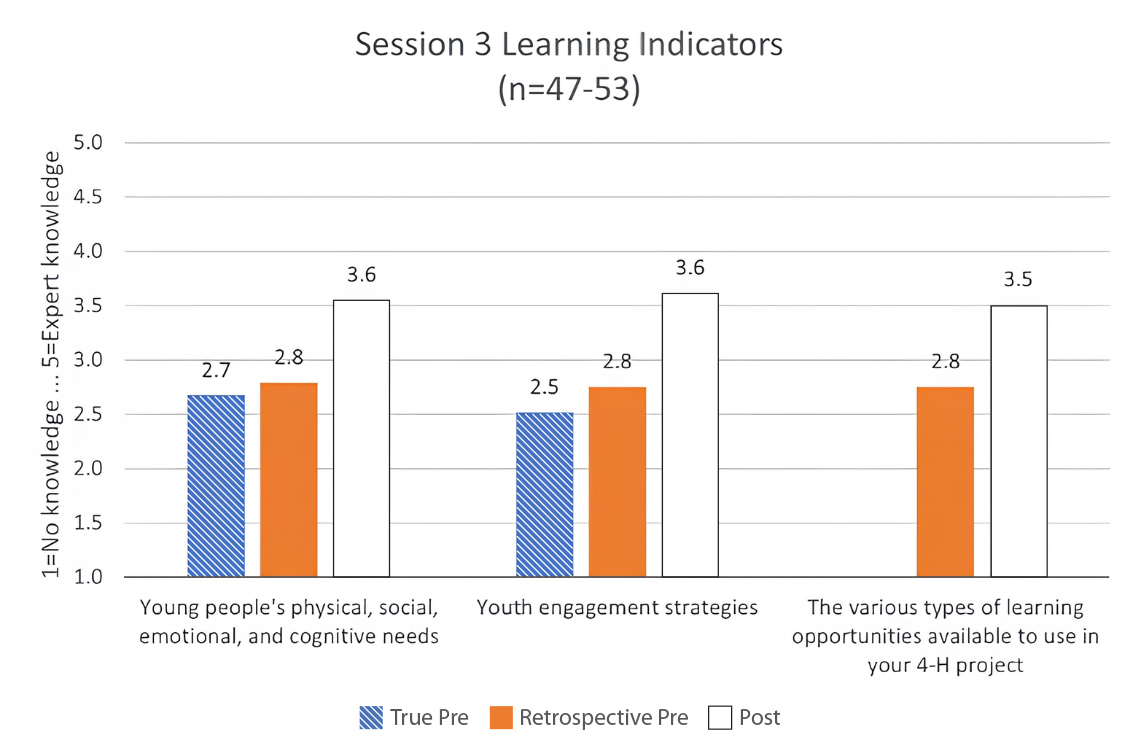
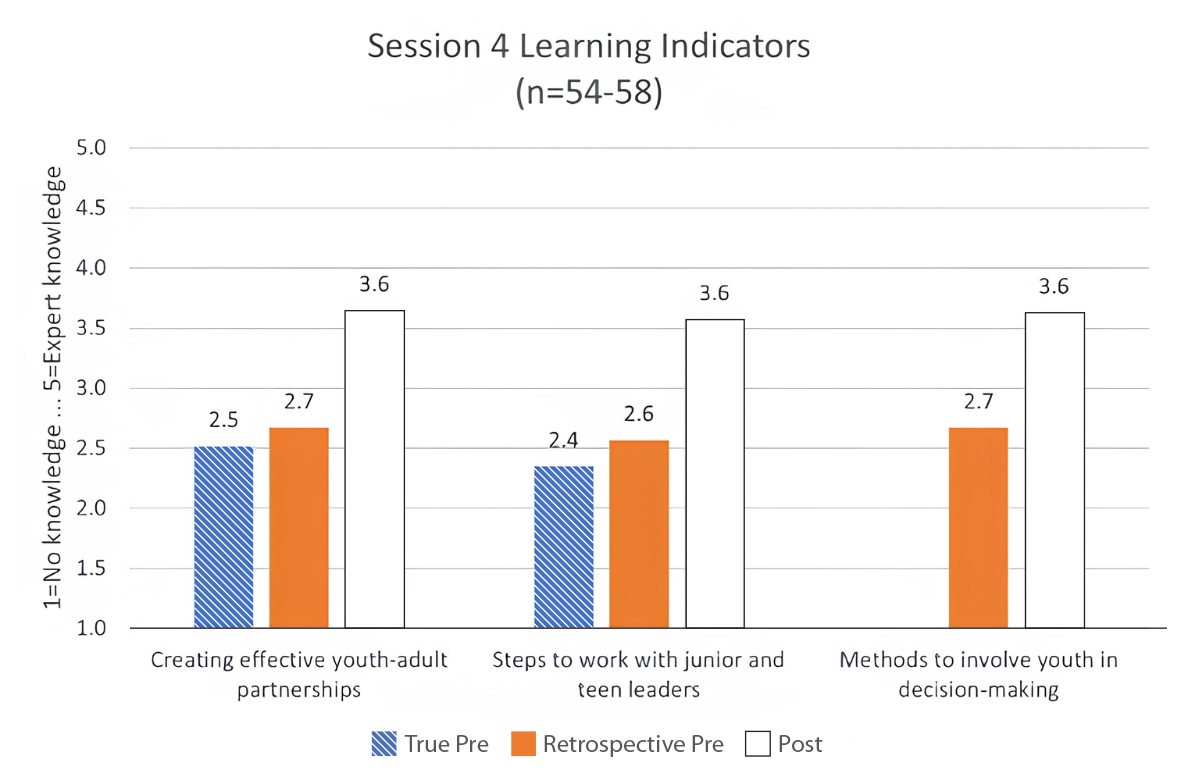
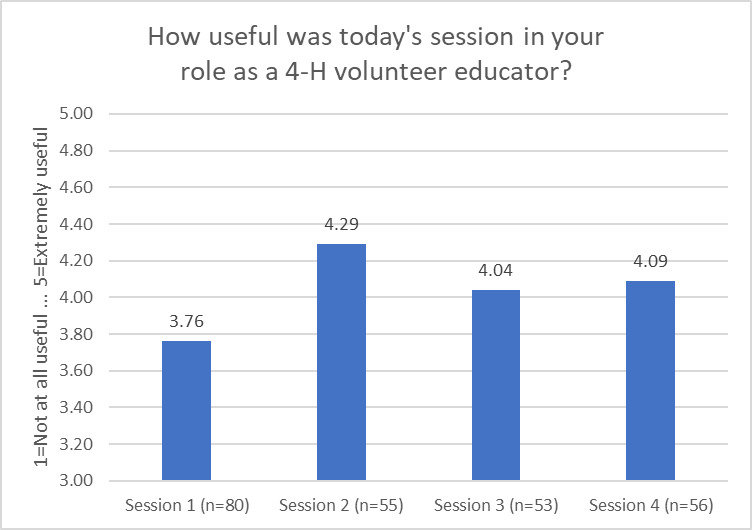
We report knowledge changes by learning indicator (see figs. 1, 2, 3, 4, and table 1), then session usefulness (fig. 5), and finally the open-ended comments.
Learning outcomes
Across all four sessions, there was a statistically significant self-reported knowledge increase as calculated by comparing retrospective-pre- to post-test means of all 14 learning indicators (paired t-tests, all were p < 0.0001). In general, knowledge moved from basic/intermediate to intermediate/advanced.
Retrospective-pre means, while diverging slightly from the true-pre means, did track the registration true-pre means, indicating minimal response-shift overall. The notable exception was Session 2’s experiential learning cycle, where participants modestly recalibrated upward at retrospective-pre; other indicators showed small or negligible differences.
Session 1
Participants reported more knowledge of the components of youth development and ways to strengthen belonging, with post ratings clustering in the intermediate to advanced range. The largest gain was “Ways to strengthen belonging in your projects”, an increase of 0.92 points from retrospective-pre to post, t(63) = 12.89, p < 0.001, Cohen’s dz = 1.61.
Session 2
The experiential learning cycle began lower than the open-questions indicator at registration, then caught up by post, indicating especially strong growth in volunteers’ understanding of the cycle alongside continued improvement in questioning strategies. The largest gain was “Ways to use broad and open questions to get youth reflecting and thinking”, which increased by 0.89 points, t(37) = 5.97, p < 0.001, Cohen’s dz = 0.97.
Session 3
Knowledge about young people’s physical, social, emotional, and cognitive needs and about engagement strategies rose to the intermediate to advanced range at post, reflecting strong perceived growth in age-appropriate practice and practical engagement tools. The largest gain was “Youth engagement strategies”, an increase of 0.81 points, t(46) = 10.32, p < 0.001, Cohen’s dz = 1.50.
Session 4
Volunteers reported an increase in knowledge about youth–adult partnerships and working with teen leaders, with some of the highest post means observed across the series. Participants left with greater knowledge in partnering effectively with youth and in concrete steps for involving junior and teen leaders. The largest gain was “Steps to work with junior and teen leaders”, which increased by 0.98 points, t(53) = 8.88, p < 0.001, Cohen’s dz = 1.21.
Perceived usefulness
Volunteers rated all sessions as useful overall (n = 244, M = 4.02, SD = 0.84 on a 1 to 5 scale), with 77% selecting 4 (Very useful) or 5 (Extremely useful). This aligns with the strong pre-post knowledge gains reported and suggests good perceived value for participants’ roles as 4-H volunteer educators. Delineated by session, Session 2 was rated as the most useful (M = 4.29, SD = 0.71) with Session 1 as the least useful (M = 3.76, SD = 0.89) (fig. 5).
What were the most important things you learned you plan to use in your 4-H projects?
We found three primary themes (n = 234):
-
Planning and tools (e.g., checklists, meeting planning): 49 mentions. “Help identify sparks and use that to plan meetings.”
-
Youth–adult partnerships (shared voice, partnership ladder): 33 mentions. “Allowing students to have a voice and to drive the curriculum with their interests.”
-
Belonging and relationships: 25 mentions. “Ideas on how to create belonging.”
Additional themes included sparks and interests (21) and ages and stages/developmental needs (10). These themes mirror the indicators that showed the largest post gains and suggest participants intend to apply concrete planning tools and relational strategies.
What would help improve the session?
We identified two primary categories (n = 207):
-
More or better breakout rooms (structure, clarity, size): 38 mentions.
-
“Better instructions and facilitation of breakout groups.”
-
“Breakout rooms were nice so more smaller group discussions.”
-
-
More concrete examples or curriculum tie-ins: 24 mentions.
- “Giving more concrete examples to implement during project meetings.”
Other comments included having Q&A time (14), better engagement and energy (13), and trouble with technology/platform (10). Requests centered on how activities translate to project meetings and on making small-group time more focused and guided.
Because the improvement comments were coded across sessions, we cannot determine whether breakout-room concerns were concentrated in one session or consistently present across all four. Practically, the comments point to specific virtual-facilitation improvements: clearer written breakout instructions, smaller groups when feasible, assigned roles, shared prompts in the chat or worksheet, timed report-outs, and facilitator check-ins during breakout time.
Strengths, trade-offs, and lessons learned
The statewide virtual series appears to be a practical and scalable way to raise 4-H volunteer educators’ knowledge on core practices that 4-H expects in high-quality youth development. Cohorts consistently showed moderate to large gains on indicators tied to belonging, experiential learning, age-appropriate practice, and youth–adult partnerships, which suggests that a brief, well-sequenced online format can help strengthen knowledge.
Three features likely contributed to these results. First, the training content aligned tightly with the UC 4-H Volunteer Educators’ Guide, reinforcing a coherent theory of practice. Second, each session modeled the experiential cycle rather than only describing it, which tracks with prior findings that reform-oriented professional learning is more likely to shift practice than one-off, lecture-style sessions (e.g., Smith and Schmitt-McQuitty 2013; Smith et al. 2017). Third, the training targeted needs that California 4-H volunteers themselves identified, such as lesson planning, child development, and practical facilitation (Go et al. 2018; Kok et al. 2020).
At the same time, an online series has trade-offs. Virtual delivery helps with fidelity and access across a large state and addresses county capacity constraints, yet it can limit informal peer learning and relationship building that matter for sustained participation. Volunteer suggestions about more structured breakouts and concrete examples support a blended strategy: keep the statewide series for core knowledge and pair it with local follow-ups that emphasize peer exchange, coaching, and context-specific planning. This is consistent with research that ongoing, learner-centered, and systems-connected development better supports behavior change than isolated workshops (Smith and Schmitt-McQuitty 2013; Smith et al. 2017). County capacity limitations may constrain local follow-up implementation. While the UC ANR Volunteer Workgroup invited 4-H professionals to facilitate place-based workshops for their 4-H volunteer educators using our supplemental training materials, and offered participation incentives, only one 4-H professional did so.
Equity and access also warrant attention. Evening virtual sessions reduced travel and widened participation, but digital access, language needs, and caregiving schedules still shape who can attend and engage. Future cohorts could add asynchronous micro-modules, captioned recordings, language support, and office-hours coaching. Counties might host short “huddles” between sessions to help volunteers adapt tools to local projects and remove barriers for first-year volunteers.
We recommend maintenance of the statewide series as the standard on-ramp for new 4-H project leaders, embedding planning tools that volunteers can reuse immediately, and formalizing a light-touch coaching cycle with 4-H professionals or experienced mentors. While incentivizing and recognizing completion was a good start, future work should aim to create a micro-credential for specific competencies (e.g., experiential facilitation, youth–adult partnership).
Preliminary evidence suggests this model is scalable. For example, a short sequence that centers experiential methods, belonging, and shared leadership might be adapted for 4-H camp chaperones. The core design rule is to keep sessions tightly aligned to theory and practice, keep them experiential, and follow with local application supports. If sustained, this approach can help 4-H narrow the gap between recommended practices and what young people actually experience in weekly project meetings, while honoring the constraints under which volunteers operate (Hensley et al. 2020; Worker 2017).
Limitations and future work
Several limitations temper interpretation. Outcomes are self-reported and short-term, so we do not yet know the extent to which volunteers changed behavior in their projects or whether youth experienced higher quality or stronger developmental outcomes. Selection effects likely operate, since those who register and attend may be more motivated. Response-shift bias is partly addressed by using a retrospective-pre design, yet measurement remains perception-based and anonymous post-session data prevent matching to registration characteristics.
Future work should connect volunteer learning to observable educator practices and to youth experience. Three concrete steps are feasible: (a) brief fidelity checks of project meetings using a simple experiential-learning and belonging rubric, (b) volunteer artifacts such as lesson plans and reflection prompts scored against clear criteria, and (c) short youth feedback items on belonging, engagement, and opportunities for leadership that can be aggregated at the county level. Longer-term, linking volunteer participation in the series to youth outcomes that 4-H already tracks would test whether professional learning translates into participant benefits.
A methodological postscript: True-pre or retrospective-pre?
Registration true-pre ratings were consistently lower than participants’ retrospective-pre ratings across indicators. This pattern may reflect recalibration after a session rather than real gains before training. For example, on the experiential learning cycle (Session 2, Indicator 1), the mean rose from 2.25 at true-pre to 2.83 at retrospective-pre, then to 3.59 at post. Immediately after a session, participants have a clearer frame of reference for what “basic,” “intermediate,” and “advanced” mean, so their recalled “before” ratings shift upward as they align their understanding with the session content.
We therefore treat the two pretest approaches as serving different purposes. The true-pre ratings describe the broader registrant pool and where volunteers believed they were starting before exposure to the content. The retrospective-pre to post ratings provide the better estimate of perceived session-related learning among attendees because both ratings were collected from the same respondents using a common post-session frame of reference. This approach can reduce response-shift concerns when training changes participants’ understanding of the constructs being rated, but it can also introduce recall, demand, attentiveness, and questionnaire-format effects (Hill 2020; Hwalek et al. 2024). For this reason, we report both forms of evidence: true-pre ratings for describing registrants and retrospective-pre to post comparisons for estimating short-term, self-reported learning among session attendees.
Acknowledgments
We appreciate the support from our colleagues who helped to co-present the sessions: Jen Henkens, Susan Weaver, and Jenna Colburn.